Choosing an ERP is a long-term decision, yet many businesses still struggle with rigid systems that are expensive, slow to adapt, and hard for teams to use. As companies grow and processes change, these limitations become even more visible.
Odoo has emerged as a strong alternative to traditional ERP systems by offering flexibility, scalability, and a modern approach to business operations. This article is for founders, business leaders, and teams evaluating ERP options and trying to understand what truly sets Odoo apart.
You will see the key reasons why businesses across industries choose Odoo over other ERP platforms, not just for cost, but for how well it fits real business needs and growth plans.
Key Takeaway
- Odoo is a modern, modular ERP designed to adapt as businesses grow.
- It offers flexibility and customization without the rigidity of traditional ERP systems.
- Lower total cost of ownership makes it accessible beyond large enterprises.
- Teams adopt Odoo faster due to its user-friendly interface.
- The real advantage of Odoo is how well it aligns with real business workflows.
Why Businesses Compare Odoo with Other ERP Systems
Most businesses start comparing ERP systems after facing the same problems: high licensing costs, rigid workflows, slow implementations, and tools that teams struggle to adopt. Traditional ERPs were built for stability, but not for speed or flexibility.
As markets change faster and businesses need to adapt quickly, many ERP systems fail to keep up. Customizations become expensive, integrations feel forced, and scaling often means buying more modules that don’t always fit together.
Odoo enters this comparison because it follows a different approach. Instead of a heavy, one-size-fits-all system, Odoo offers a modular platform that can be shaped around how a business actually works. This is why companies evaluating ERP options often place Odoo alongside larger, established systems and reassess what they truly need from an ERP.
1. Modular Design That Grows with Your Business
Most traditional ERPs force businesses to adopt everything upfront, even when only a few features are needed. This often leads to higher costs, longer implementations, and unused functionality.
Odoo works differently. Its modular design allows businesses to start with only the apps they need, such as CRM, Sales, Accounting, or Inventory, and add more as the business grows. This makes Odoo practical for startups and equally suitable for scaling companies.
The result is an ERP that grows alongside the business instead of restricting it. Teams can adapt processes over time without reimplementing the entire system.
2. Lower Total Cost of Ownership
One of the biggest reasons businesses choose Odoo over other ERPs is the overall cost, not just the initial price tag. Traditional ERP systems often come with high licensing fees, expensive upgrades, and long-term vendor dependencies.
Odoo reduces total cost of ownership by offering flexible licensing, modular adoption, and lower customization effort. Businesses pay for what they use and scale costs gradually as their needs grow.
Over time, this makes Odoo more predictable and sustainable, especially for companies that want control over their ERP budget without sacrificing functionality.
3. Open-Source Flexibility without Vendor Lock-In
Many traditional ERPs lock businesses into proprietary systems where changes, integrations, and even data access depend on the vendor. This limits flexibility and increases long-term dependency.
Odoo’s open-source foundation gives businesses more control. They can customize workflows, integrate with other tools, and access their data without being restricted to a single vendor’s roadmap or pricing model.
This flexibility allows companies to adapt Odoo as their operations evolve, making it a practical choice for businesses that value independence and long-term control over their ERP system.
4. All-in-One Platform Instead of Disconnected Tools
Many businesses rely on multiple disconnected tools for sales, accounting, inventory, HR, and operations. While this may work initially, it often leads to data silos, manual work, and reporting gaps as the business grows.
Odoo brings these functions into a single, unified platform with one database. Sales, finance, inventory, and operations stay connected, so information flows naturally across teams without duplication or manual syncing.
This all-in-one approach improves visibility, reduces errors, and helps businesses make faster, more informed decisions using real-time data.
5. Easier Customization Compared to Traditional ERPs
Traditional ERPs often make customization complex, expensive, and risky. Even small changes can require vendor approval, long development cycles, or impact future upgrades.
Odoo is designed to be customized around real business workflows. Its modular structure and open framework allow changes to be implemented faster without breaking the core system. Businesses can adapt processes, add features, and integrate third-party tools with less friction.
This makes Odoo practical for companies whose operations evolve over time, where the ERP needs to support change instead of resisting it.
6. Faster Implementation and Time to Value
Many ERP projects fail because they take too long to deliver usable results. Long timelines increase cost, delay adoption, and disrupt daily operations.
Odoo supports a phased implementation approach. Businesses can go live with core modules first and expand gradually, reducing risk and delivering value sooner. This makes it easier for teams to adapt while keeping the system aligned with real workflows.
For companies that want to avoid drawn-out ERP projects, a structured Odoo implementation approach helps ensure faster rollout, clearer milestones, and quicker returns from day one.
7. User-Friendly Interface That Teams Actually Adopt
An ERP system only delivers value if people actually use it. Many traditional ERPs struggle with adoption because their interfaces are complex and require extensive training.
Odoo focuses on a clean, modern interface that feels intuitive even for non-technical users. Teams can navigate modules, complete tasks, and access information with minimal training, which reduces resistance during rollout.
Higher adoption leads to better data accuracy, smoother workflows, and faster returns on the ERP investment.
8. Scales from Startups to Enterprises
Many ERP systems are built for a specific business size, which creates problems when companies grow. Startups outgrow lightweight tools, while mid-sized businesses struggle with systems designed only for large enterprises.
Odoo scales smoothly across stages. Businesses can start small with basic modules and gradually add advanced features, multi-company setups, multi-warehouse operations, or multi-country accounting as they expand.
This scalability allows companies to grow on the same ERP platform without needing a costly replacement later, making Odoo a long-term solution rather than a temporary one.
9. Strong Ecosystem and Continuous Innovation
An ERP system is not static. It must evolve as business needs, technologies, and regulations change. Many traditional ERPs update slowly, making innovation dependent on long upgrade cycles.
Odoo benefits from a strong global ecosystem of developers, partners, and contributors who continuously improve the platform. New features, enhancements, and industry-specific apps are released regularly through Odoo updates and the app marketplace.
This steady innovation ensures businesses are not locked into outdated systems and can adopt new capabilities without waiting years for major upgrades.
10. Fits Real Business Workflows, Not Just Processes
Many ERP systems force businesses to change how they work to match predefined processes. This often leads to workarounds, manual steps, and frustration across teams.
Odoo is designed to adapt to real business workflows instead. Its flexibility allows companies to align the ERP with how their sales, operations, finance, and support teams actually operate, not how a rigid system expects them to.
This workflow-first approach helps businesses run more efficiently, reduce friction between teams, and get practical value from their ERP on a daily basis.
Common Misconceptions About Odoo ERP
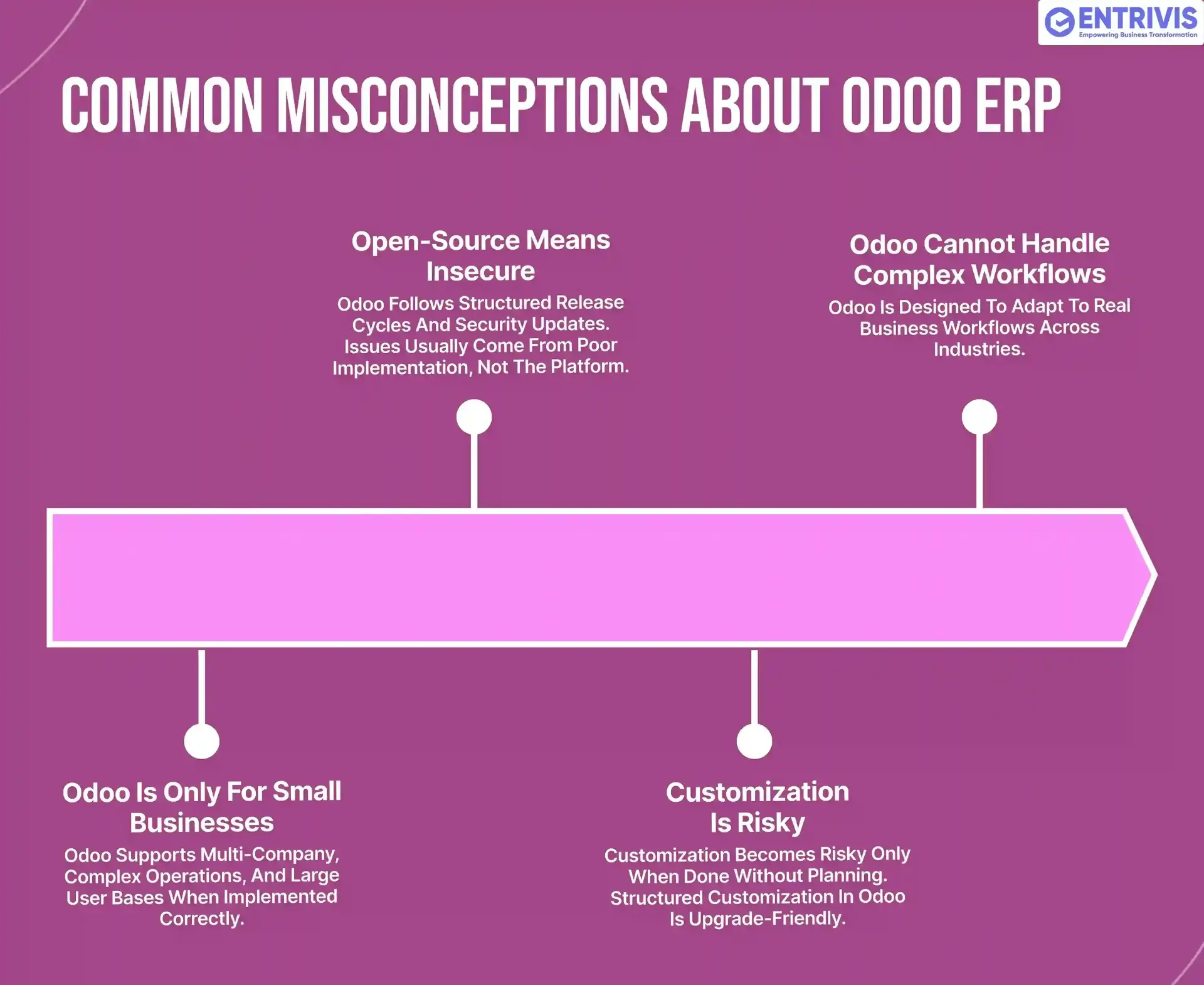
- Odoo is only for small businesses
Odoo supports multi-company, complex operations, and large user bases when implemented correctly. - Open-source means insecure
Odoo follows structured release cycles and security updates. Issues usually come from poor implementation, not the platform. - Customization is risky
Customization becomes risky only when done without planning. Structured customization in Odoo is upgrade-friendly. - Odoo cannot handle complex workflows
Odoo is designed to adapt to real business workflows across industries.
Key takeaway: Odoo’s success depends more on how it is implemented than on the software itself.
What to Do Next
If you are evaluating ERP options and want a system that can adapt as your business grows, Odoo deserves serious consideration. The real difference comes from choosing the right implementation approach, not just the software.
Entrivis Tech Pvt Ltd helps businesses assess whether Odoo is the right fit, plan a structured implementation, and avoid common ERP mistakes. Whether you are moving from another ERP or starting fresh, expert guidance can save time, cost, and rework.
To discuss your requirements or explore Odoo for your business, contact Entrivis Tech Pvt Ltd and speak with an ERP expert about the right next steps.
FAQs About Odoo ERP
1. Is Odoo suitable for large enterprises?
Yes. Odoo supports multi-company operations, large user bases, and complex workflows when implemented with the right architecture.
2. How does Odoo compare with SAP or Oracle?
Odoo is more flexible and modular, with lower total cost of ownership. SAP and Oracle are powerful but often rigid and expensive to adapt.
3. Is Odoo expensive to maintain?
Odoo maintenance costs are predictable when implemented correctly. Costs mainly depend on usage, customization level, and support requirements.
4. How long does an Odoo implementation take?
Implementation time varies by scope. Small deployments can take weeks, while larger implementations are rolled out in structured phases.
5. Can Odoo replace multiple business tools?
Yes. Odoo can replace CRM, accounting, inventory, HR, and operations tools by bringing them into a single integrated platform.