Every business that decides to implement Odoo starts with a clear goal: streamline operations, reduce manual work, and build a system that scales. Most reach go-live eventually. But the gap between a smooth implementation and a difficult one is wider than most decision-makers anticipate, and the consequences of that gap show up long after the project closes.
Delayed timelines, budget overruns, low user adoption, data that doesn't reconcile cleanly; these aren't rare outcomes. They're predictable patterns that emerge when Odoo ERP implementation is approached without adequate planning, the right expertise, or a realistic understanding of what the process involves.
This guide is written for business owners, operations heads, and CTOs who want to go in with eyes open, understanding the challenges that commonly derail implementations, and how to address them before they become expensive problems.
What Is Odoo ERP Implementation?
Odoo implementation is the structured process of deploying Odoo across your business, configuring it to match your workflows, migrating your existing data, integrating it with other tools you rely on, training your team, and transitioning from your current systems to a fully operational Odoo environment.
It moves through defined phases: discovery and requirement analysis, system design, module configuration and customization, data migration, integration setup, user acceptance testing, training, and go-live. Post-deployment support typically follows as an ongoing engagement.
Each phase matters. The quality of your requirement analysis shapes everything that comes after it. The care taken during data migration determines whether your historical records are trustworthy on day one. The depth of your user training determines whether your team embraces the system or works around it.
Implementation is not a short process, and it isn't a simple one. But with the right approach and the right partner, it's entirely manageable.
Why Businesses Choose Odoo ERP
Before examining the challenges, it's worth understanding why Odoo has become the platform of choice for a growing number of businesses across India and globally.
Odoo's modular architecture means you deploy what you need now and expand as your business grows. You're not paying for functionality you don't use, and you're not locked into a rigid system that can't accommodate how your business evolves. Start with accounting and inventory. Add manufacturing, HR, and CRM when the time is right. The platform grows with you.
Its open-source foundation gives businesses genuine ownership of their system, no vendor lock-in, no arbitrary licensing constraints. And its cost structure makes it accessible to MSMEs that would previously have been priced out of enterprise-grade ERP.
For Indian businesses specifically, Odoo's localization for GST, e-invoicing, TDS, and statutory compliance makes it a practical choice, not just a capable one. Explore Odoo ERP solutions across industries to understand the full scope of what the platform delivers.
That said, the platform's flexibility is also what makes implementation non-trivial. More configuration options mean more decisions. More modules mean more integration points. And more customization potential means more room for the project to drift if it isn't managed well.
Top Challenges in Odoo ERP Implementation
Understanding these challenges isn't cause for concern; it's cause for preparation. Each of the following issues is predictable, and each has a clear path to resolution when addressed proactively.
Lack of Clear Business Requirements
This is where more implementations go wrong than any other single factor. A project that begins without a thoroughly documented understanding of how your business actually operates will inevitably produce a system that fits a theoretical version of your business, not the real one.
The scenario plays out consistently: the initial discovery conversations are high-level, the scope is documented loosely, and the implementation team begins configuration based on assumptions. Six weeks in, the finance team raises requirements that weren't captured. The operations team describes workflows that contradict what was documented. Changes accumulate, timelines extend, and the budget follows.
Clear, detailed business requirements aren't just a project management formality. They're the foundation on which every configuration decision is made. Before your Odoo implementation begins, every department that will use the system should have participated in structured discovery sessions, and their requirements should be documented, reviewed, and signed off.
The investment in thorough discovery almost always costs less than the corrections it prevents.
Poor Change Management
An ERP system changes how your team works. That's the point. But change, even change for the better, meets resistance when people feel it's being imposed on them rather than introduced with them.
We've seen well-configured Odoo systems underperform because the team using them wasn't properly prepared for the transition. Your warehouse staff has been using the same picking process for three years. Your finance team has a month-end routine built around their current tools. When Odoo replaces those routines without adequate communication, training, and support, resistance is the natural response.
Change management in an Odoo ERP implementation means more than scheduling training sessions. It means communicating the why behind the change early, involving team leads from each department in the configuration process, creating internal champions who support their colleagues through the transition, and building in enough time for people to become comfortable before go-live.
A technically perfect system with low adoption is still a failed implementation. The human side of this project deserves as much attention as the technical side.
Data Migration Challenges
Your existing data, customer records, vendor details, historical transactions, inventory balances, open payables, and receivables need to move into Odoo accurately before you can go live. This is consistently underestimated as a project workload.
The challenge isn't just moving data from one system to another. It's that data accumulated in legacy systems over the years is often inconsistent, duplicated, or structured in ways that don't map cleanly to Odoo's data model. A customer might appear three times in your current CRM under slightly different names. Your inventory records might carry obsolete SKUs that were never cleaned up. Historical invoices might reference accounts that no longer exist.
Migrating this data without first cleaning and validating it produces a new system populated with old problems. And discovering those problems after go-live, when your team is already adjusting to a new system, compounds the difficulty considerably.
Data migration deserves its own scoped phase: audit your existing data, map it to Odoo's structure, clean and deduplicate, migrate to a staging environment, validate against business expectations, and only then move to production. ERP migration services handled by an experienced partner will follow exactly this sequence.
Customization Complexity
Odoo's customization capability is one of its genuine strengths. It's also one of the most common sources of project complexity and long-term maintenance burden when that capability is applied without restraint.
Over-customization happens when every edge case and exception in your current process gets built into the new system. The result is a heavily modified Odoo instance that's expensive to maintain, difficult to upgrade, and dependent on the original development team for even small changes.
The discipline required in Odoo ERP implementation services is knowing when to customize and when to configure and, occasionally, when to accept that Odoo's standard approach is better than your current one. A skilled Odoo customization services provider will challenge requirements that call for custom code when native functionality is genuinely sufficient, and will write upgrade-safe custom modules when development is truly necessary.
Not every business process needs to be preserved exactly as it exists today. Implementation is also an opportunity to evaluate whether current processes are as efficient as they should be.
Integration with Existing Systems
Most businesses don't replace every tool when they implement Odoo. You may retain a third-party payment gateway, a customer-facing e-commerce platform, a logistics management tool, or a legacy system in a specific department that isn't being migrated yet. Each of these needs to exchange data with Odoo reliably.
Integration work is technically demanding and often takes longer than anticipated, particularly when the external system has limited API documentation or an older architecture that doesn't connect cleanly. An integration that works in testing may behave differently under production load. And external systems change: an API update from your payment provider can break a connection without warning.
Identifying every integration requirement during the discovery phase and scoping each one explicitly prevents integration work from becoming a last-minute scramble before go-live. Odoo ERP solutions with built-in integration capabilities handle many common connections natively, but custom integrations require careful planning and testing.
Lack of Skilled Implementation Partner
Every other challenge on this list becomes more manageable with the right partner involved. Most of them become harder, sometimes significantly harder, without one.
An inexperienced implementation team may document requirements inadequately, configure modules without testing edge cases, apply customizations that create upgrade issues, or deliver training that doesn't reflect how your team actually works. The gaps often aren't visible until after go-live, when they manifest as user complaints, data errors, or performance problems.
Choosing an Odoo development company with verifiable industry experience, certified resources, a structured methodology, and a defined post-go-live support model isn't just a quality consideration. It's a risk management decision. The cost differential between a skilled partner and a less experienced one is typically a fraction of the cost of correcting a troubled implementation.
How to Overcome These Odoo Implementation Challenges
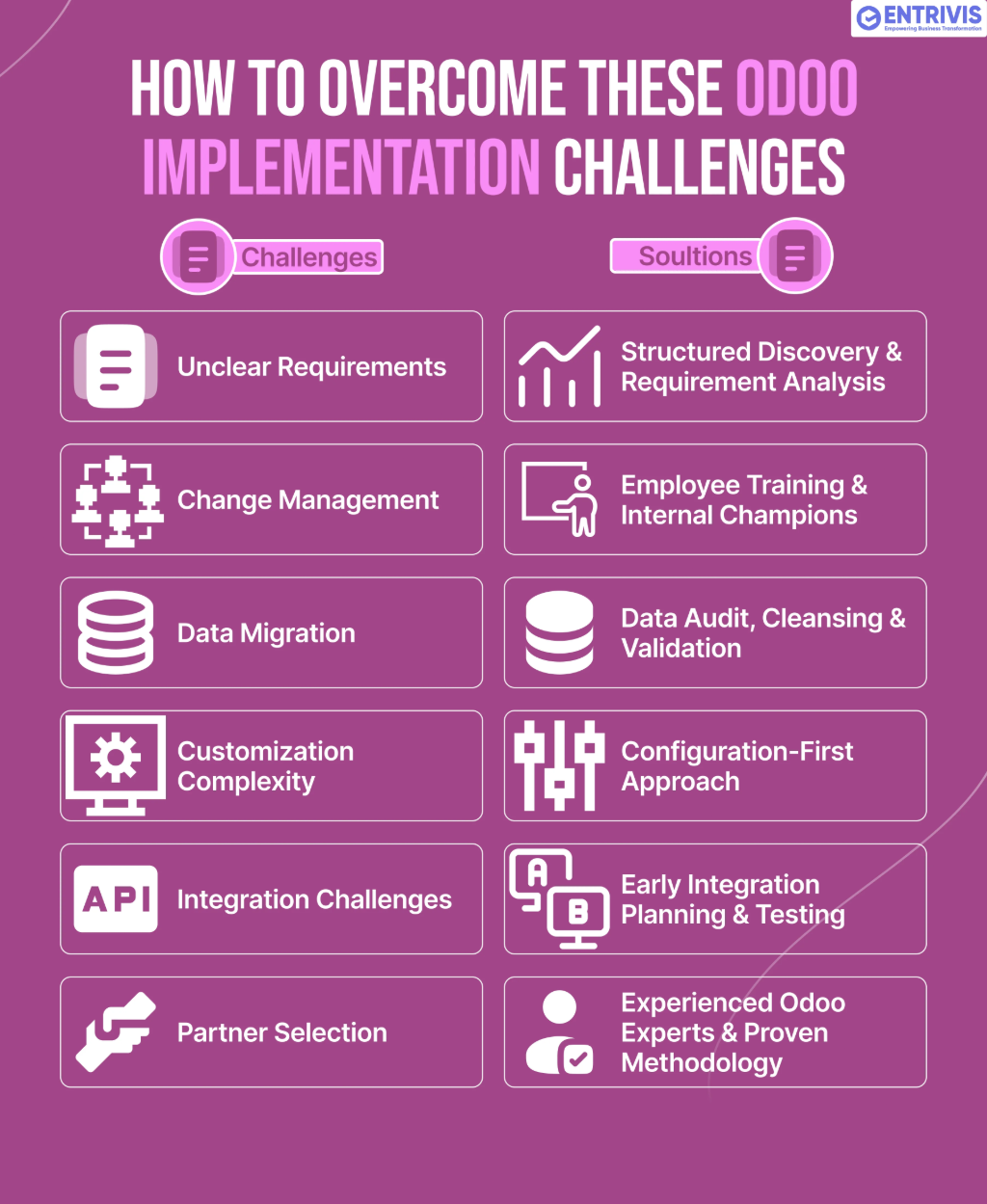
Each challenge described above has a corresponding response, most of which involve decisions made before the project begins rather than corrections made after problems surface.
- For unclear requirements: Invest in a structured discovery phase before any configuration begins. Involve department leads, document workflows at the process level, and require sign-off on requirements before the design phase starts. If your partner offers a formal ERP consulting services engagement as a precursor to implementation, treat it as essential, not optional.
- For change management: Appoint internal project champions in each department. Communicate the purpose and timeline of the transition early. Design training around how people actually work, not how the software works in theory. Schedule a parallel-run period where teams use both systems before the old one is retired.
- For data migration: Dedicate time and resources to a pre-migration data audit. Establish clear data quality standards before migration begins. Migrate to staging, validate thoroughly, and document every exception. Plan your go-live data cutoff carefully. The cleaner your opening balances, the smoother your first weeks on the system.
- For customization complexity: Establish a clear decision framework configuration first, and customization only when genuinely necessary. Review every customization request against Odoo's standard functionality before approving development. Write a brief business justification for each custom module. This discipline protects your long-term upgrade path and reduces maintenance costs.
- For integration challenges: Map every integration point during discovery. Scope each one explicitly in your project plan. Build and test integrations in staging, not production. Establish monitoring for critical connections so failures surface immediately rather than silently.
- For partner selection: Evaluate partners on track record, industry experience, certified resources, methodology, and post-go-live support model, not on price alone. Request references from businesses with similar complexity to yours. A partner who asks hard questions during discovery and pushes back on requirements that would create problems is a better indicator of quality than one who agrees with everything.
Best Practices for Successful Odoo ERP Implementation
These practices don't eliminate complexity, but they consistently separate implementations that deliver on their promise from those that fall short.
- Complete a formal business requirement analysis before any configuration begins
- Assign a dedicated internal project owner with decision-making authority
- Involve department leads in requirements gathering and UAT
- Define data migration scope and quality standards before the project starts
- Use a staging environment for all development, testing, and data validation
- Establish a clear customization decision framework configuration first
- Map and scope every integration requirement during discovery
- Design training around real workflows, not software features
- Define go-live criteria clearly, don't go live until UAT is complete
- Secure post-go-live support before the project ends, not after
- Conduct a formal project review four to six weeks after go-live
Each item on this list represents a point where implementations commonly go off course when the step is skipped or compressed under time pressure.
Role of Odoo ERP Implementation Services in Success
The value a qualified Odoo ERP implementation services partner brings to a project isn't primarily technical. It's experiential. They've navigated the challenges described in this guide across multiple projects, in multiple industries, at multiple scales. That experience translates into fewer surprises, better decisions at each phase, and a higher probability of a go-live that your team is proud of rather than exhausted by.
Specifically, a strong implementation partner brings structured discovery practices that surface requirements your internal team might not think to document. They bring a configuration approach that balances customization with upgrade safety. They bring a data migration methodology that validates before it commits. And they bring post-go-live support that ensures the system continues to evolve with your business rather than stagnating after deployment.
Odoo support services from your implementation partner, structured as an ongoing retainer rather than a reactive break-fix arrangement, are what convert a successful go-live into a system that delivers compounding value over time. The implementation is the foundation. Support is what builds on it.
Business process automation embedded within a well-implemented Odoo system doesn't just save time; it creates the operational consistency that lets your business scale without proportionally scaling its complexity.
Cost & Timeline Expectations for Implementation
Two questions come up in every implementation conversation: How long will it take? And what will it cost? Both answers depend on factors that are specific to your business, which is why any partner who quotes without first understanding your requirements is guessing.
What drives the timeline:
- Number of modules being implemented and their interdependencies
- Volume and quality of data being migrated
- Number and complexity of third-party integrations
- Degree of customization required
- Size of the user base and training requirements
- Availability of your internal team for discovery, UAT, and sign-off
A straightforward Odoo implementation for a single-entity business with standard module requirements and clean data might be completed in eight to twelve weeks. A multi-entity implementation with custom workflows, complex integrations, and a large user base typically runs six months or longer. Being honest about your complexity from the start produces a more accurate timeline than optimistic scoping.
What drives cost:
- Scope of configuration and customization
- Data migration complexity
- Integration development requirements
- Training scope and format
- Post-go-live support model
The total cost of Odoo ERP implementation is best evaluated as a three-to-five-year investment, not a one-time expenditure. When you factor in the operational efficiency gains, reduced manual effort, lower compliance risk, and avoided error-correction costs, the return on a well-executed implementation typically exceeds the initial investment well within the first two years.
Cost transparency from your partner, itemized proposals with clearly scoped deliverables, is both a practical requirement and an indicator of professionalism. Vague or shifting pricing is a red flag worth taking seriously.
Final Thoughts: Turning Challenges into Opportunities
Every challenge in Odoo ERP implementation is knowable in advance. None of them is inevitable. The businesses that navigate implementations successfully aren't necessarily larger or more technically sophisticated than those that struggle; they're better prepared, better supported, and more deliberate in their decisions before the project begins.
The right approach treats implementation not as a technology project but as a business transformation initiative, one that deserves careful planning, appropriate resources, and a partner who's genuinely invested in the outcome.
At Entrivis Tech, we've built our implementation practice around exactly this philosophy. We ask the hard questions during discovery. We challenge requirements that would create long-term problems. We document thoroughly, test carefully, and stay engaged after go-live because that's where the real value of the system is either captured or missed.
If you're planning an Odoo implementation or evaluating whether to move forward with one, we're happy to have a straightforward conversation about what your business needs and what a well-structured engagement looks like.
Schedule your free Odoo consultation with Entrivis Tech
FAQs on Odoo ERP Implementation
What is Odoo ERP implementation?
Odoo ERP implementation is the end-to-end process of deploying Odoo across your business, covering discovery, configuration, data migration, integrations, user training, and go-live. A structured implementation ensures Odoo aligns with your actual workflows rather than a generic template.
How long does Odoo ERP implementation take?
Timelines range from eight weeks for a simple, single-entity deployment to six or more months for complex, multi-entity projects with custom integrations. Scope, data volume, and customization requirements are the primary drivers. A realistic timeline is established during the discovery phase, not before it.
What are the most common Odoo implementation challenges?
The most frequent issues are unclear requirements going into the project, poor user adoption, data migration errors, over-customization, and integration gaps with existing tools. All are preventable with proper planning and an experienced implementation partner.
How much does Odoo ERP implementation cost?
Implementation cost varies based on scope, number of modules, customization requirements, integrations, and training needs. Evaluating the total cost of ownership over three to five years, factoring in operational efficiency gains and avoided manual overhead, gives a more accurate picture than comparing upfront quotes alone.
Do I need an Odoo implementation partner?
For businesses with any meaningful operational complexity, yes. An experienced partner manages risk, brings proven methodology, and ensures the system is configured to deliver long-term value, not just a functional go-live. Self-implementation is viable for very simple deployments with standard requirements only.
What happens after Odoo goes live?
Post-go-live support covers bug resolution, user queries, performance tuning, and ongoing enhancements as your business evolves. Odoo support services structured as a retainer ensure continuous system health rather than reactive problem-solving.
Can Odoo integrate with my existing tools?
Yes. Odoo supports integration with a wide range of third-party platforms, payment gateways, e-commerce systems, logistics tools, banking feeds, and legacy ERPs. Integration complexity varies by system; each connection should be scoped explicitly during the discovery phase.
What is the difference between Odoo configuration and customization?
Configuration uses Odoo's built-in settings and options to match your requirements faster, at a lower cost, and upgrade-safe. Customization involves writing code to extend or modify Odoo's native behavior. A skilled partner pursues configuration first and applies customization only when the business case genuinely justifies it.