Tax compliance is one of those business responsibilities that punishes delay and rewards precision. Whether you're filing GST returns in India, managing VAT across European markets, or handling multi-jurisdiction tax rules in a growing international operation, the margin for error is almost zero.
The consequences of getting it wrong are well documented: penalties, interest charges, audit triggers, and in serious cases, business disruptions that take months to untangle. Yet for many businesses, tax compliance is still managed through a patchwork of spreadsheets, disconnected accounting tools, and manual processes that haven't fundamentally changed in years.
Odoo VAT management offers a different approach, one where tax rules are embedded directly into your business workflows, calculations happen automatically at the point of transaction, and compliance reports are generated without scrambling at the end of every filing period.
This guide walks through how Odoo handles GST and VAT compliance, what it replaces, and whether it's the right fit for your business.
What Is GST & VAT Compliance?
Before exploring the solution, it helps to be clear on what compliance actually involves, because "filing taxes" dramatically undersells the complexity businesses deal with in practice.
GST (Goods and Services Tax) is a destination-based consumption tax applied across the supply chain. In India, it operates across multiple slabs (0%, 5%, 12%, 18%, 28%), with different rules for interstate vs. intrastate transactions, input tax credit (ITC) eligibility, reverse charge mechanisms, and e-invoicing mandates for businesses above a certain turnover threshold.
VAT (Value Added Tax) is the equivalent framework used across most of Europe, the Middle East, Southeast Asia, and other regions. While the structural logic is similar to GST, the rates, exemptions, filing frequencies, and reporting formats vary significantly by country.
Compliance, in practical terms, means:
- Applying the correct tax rate to every transaction
- Maintaining accurate records for every invoice issued and received
- Reconciling input and output tax periodically
- Filing returns on schedule (monthly, quarterly, or annually, depending on jurisdiction)
- Generating audit-ready documentation when required
- Staying current as tax laws change
For a business operating in multiple states or countries, this isn't a once-a-month task; it's a continuous operational responsibility.
Challenges in Manual Tax Compliance
Most businesses don't start with a compliance problem. They start with a spreadsheet that works fine at a small scale, and only discover the cracks when transaction volumes grow, teams expand, or a tax notice arrives.
Here are the pain points that show up most consistently:
- Human error in tax code application - A single misclassified product or incorrect HSN code can invalidate an entire invoice and trigger ITC rejection
- Rate changes missed in time - GST rate revisions require immediate updates across all invoicing templates, product masters, and tax rules. Manual systems lag
- Reconciliation gaps - When sales data, purchase data, and accounting entries live in different systems, GSTR-2A mismatches become a monthly headache
- Multi-state complexity - Businesses with operations across multiple Indian states must manage CGST, SGST, and IGST correctly for every transaction
- E-invoicing and IRN generation - For eligible businesses, invoices must be registered with the Invoice Registration Portal in real time. Manual workflows struggle here
- Audit trail fragility - When records are maintained in spreadsheets or disconnected tools, producing a clean audit trail under scrutiny is difficult and time-consuming
- Multi-country VAT - For businesses with international operations, managing different VAT rates, return formats, and filing deadlines across jurisdictions manually is genuinely unsustainable
Each of these challenges compounds as the business grows. The cost isn't always visible in the balance sheet; it shows up in staff hours, delayed invoicing, missed ITC claims, and the quiet anxiety of not being entirely sure the numbers are right.
How Odoo ERP Simplifies Tax Compliance
Odoo approaches tax compliance differently from standalone accounting tools. Rather than treating tax as a reporting function that happens after transactions are recorded, Odoo VAT management embeds tax logic directly into the transaction layer, so accuracy is built in from the start.
Here's how the core capabilities work in practice:
Automated Tax Calculation
Every time a sale, purchase, or expense is recorded in Odoo, the system applies the correct tax rate automatically, based on pre-configured tax rules tied to product categories, customer location, and transaction type.
For Indian businesses, this means:
- CGST and SGST are applied automatically for intrastate transactions
- IGST is triggered for interstate supplies without manual intervention
- HSN/SAC codes are mapped at the product level and appear on every invoice
- The reverse charge mechanism is flagged and handled correctly for eligible transactions
- E-invoicing with IRN generation is integrated directly into the invoicing workflow for eligible businesses
The practical benefit: your team doesn't need to think about which tax code applies. The system handles it consistently, at scale, without fatigue-driven errors.
Multi-Country Tax Support
For businesses operating across borders, Odoo's localization framework is one of its most significant capabilities. Odoo supports tax configurations for over 80 countries, with country-specific tax rules, filing formats, and compliance standards maintained through its localization modules.
This means a business managing GST in India, VAT in the UAE, and EU VAT for European customers can run all three within the same Odoo instance, with each entity's tax rules operating independently, correctly, and in compliance with local standards.
Odoo's multi-currency and multi-company architecture ensures that consolidated reporting doesn't create cross-contamination between tax jurisdictions, a genuine pain point for businesses that outgrow single-country accounting tools.
Real-Time Reporting & Filing
Compliance reporting in Odoo isn't an end-of-period scramble; it's a continuous output of the system's normal operation.
Built-in tax reports include:
- GSTR-1 (outward supply summary) auto-populated from sales invoices
- GSTR-3B summary for monthly filing
- VAT return reports for applicable countries
- Input Tax Credit (ITC) registers reconciled against purchase entries
- Tax audit trails with full transaction-level drill-down
- Custom dashboards showing tax liability position in real time
When your books are maintained in Odoo, filing preparation time drops significantly, because the report is essentially always ready. What used to take a finance team two to three days of manual compilation becomes a matter of reviewing and confirming what the system has already organized.
Key Features of Odoo VAT Management
The depth of Odoo VAT management goes beyond basic tax calculation. Here's a more complete picture of what the platform provides:
- Tax position mapping - Configure rules that automatically switch tax treatments based on customer type (B2B vs B2C), geographic location, or supply category
- Fiscal positions - Apply different tax rules for different customer or vendor profiles without modifying the base product configuration
- Tax groups - Aggregate multiple tax components (e.g., CGST + SGST) into a single line on invoices for cleaner presentation
- Tax rounding rules - Handle rounding at the line level or invoice level in compliance with jurisdiction-specific requirements
- Deferred tax handling - manage cash-basis vs. accrual-basis tax recognition based on your accounting method
- Tax lock dates - Prevent backdated entries from altering already-filed tax periods
- Credit notes and refund tax handling - Reverse tax entries accurately when credit notes are issued, maintaining reconciliation integrity
- e-Invoice integration - Direct IRN generation for Indian businesses above the mandatory e-invoicing threshold
- HSN/SAC code management - Product-level code assignment with automatic population on invoices and GST returns
- Vendor bill tax reconciliation - Match input tax credit against vendor invoices to identify and resolve GSTR-2A mismatches early
Each of these features addresses a specific compliance failure point. Together, they create a tax management environment where accuracy is the default, not something the team has to chase.
Benefits of Using Odoo for GST & VAT Compliance
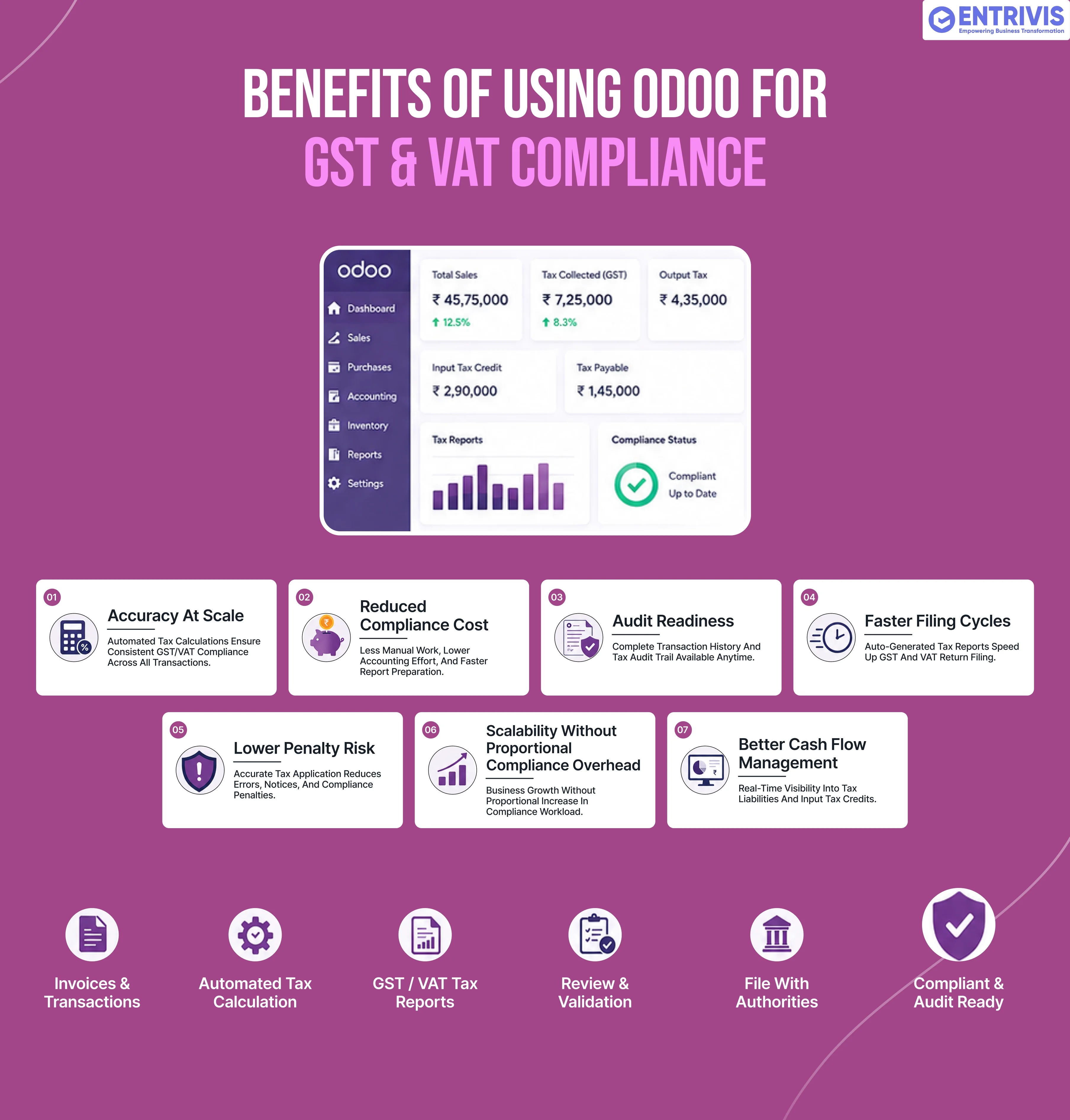
The value of Odoo ERP services for tax compliance isn't just operational; it shows up in risk reduction, cost savings, and strategic clarity.
Accuracy at scale - Automated tax rules eliminate the manual error risk that grows proportionally with transaction volume. Whether you're processing 100 invoices a month or 10,000, the tax logic applies consistently.
Reduced compliance cost - Finance teams spend less time on data entry, reconciliation, and report preparation. This translates directly to reduced overtime, fewer external accounting consultancy hours, and faster month-end close.
Audit readiness, always - Because every transaction carries a complete tax audit trail, responding to a GST department query or tax audit doesn't require reconstructing records from disparate sources. Everything is already there.
Faster filing cycles - When reports are auto-generated from live transaction data, the time between period close and return filing compresses significantly.
Lower penalty risk - Correct tax application from the point of transaction means fewer mismatches, fewer notices, and fewer penalties, all of which have a direct financial impact.
Scalability without proportional compliance overhead - As the business grows, the compliance function doesn't need to grow at the same rate. Odoo's automation absorbs volume without requiring proportional headcount.
Better cash flow management - Real-time visibility into tax liability and ITC position allows for more accurate cash flow forecasting, particularly valuable for businesses where tax timing significantly affects working capital.
Odoo VAT Management vs Traditional Systems
Parameter | Manual / Traditional Systems | Odoo VAT Management |
Tax Calculation | Manual, error-prone | Automated at the transaction level |
Rate Updates | Requires manual intervention across tools | Updated centrally; applies instantly |
Multi-Jurisdiction Support | Difficult; usually requires separate tools | Built-in localization for 80+ countries |
GSTR / VAT Filing | Manual compilation from multiple sources | Auto-generated from live data |
Audit Trail | Fragmented; difficult to reconstruct | Complete, transaction-level, always available |
e-Invoicing | External tools or manual upload | Integrated IRN generation |
ITC Reconciliation | Time-intensive, spreadsheet-based | Automated matching with GSTR-2A |
Scalability | Degrades with volume | Handles growth without performance loss |
Real-Time Visibility | Limited or delayed | Live dashboards and tax liability reports |
Error Detection | Post-facto, often discovered at filing | Flagged at the entry point |
Total Compliance Cost | High (staff time + risk + penalties) | Lower over time with automation |
The table above reflects a pattern that most finance teams recognize: traditional systems work until they don't, and by the time the cracks appear, the backlog of issues is already significant.
Implementation Considerations
Making the move to Odoo for tax compliance is a structured process, not a plug-and-play installation. Working with experienced Odoo implementation services ensures that your tax configuration reflects your actual business operations, not a generic template.
Key implementation steps to plan for:
- Tax rule mapping - Document all applicable tax codes, rates, and scenarios before configuration begins
- Product and service categorization - Assign HSN/SAC codes and default tax treatments to every product and service in your catalog
- Customer and vendor tax profiles - Configure fiscal positions for different customer types (domestic B2B, domestic B2C, export, SEZ, etc.)
- Opening balance migration - Ensure historical tax data is accurately carried forward if migrating from an existing system
- e-Invoicing setup - For eligible businesses, configure IRN integration with the Invoice Registration Portal
- Report validation - Run parallel filing cycles during go-live to validate that Odoo-generated returns match expected figures before fully transitioning
- Staff training - Finance teams need to understand how tax logic works in Odoo so they can identify and report anomalies confidently
If your business is currently on a different ERP or accounting platform, Odoo migration services can ensure that the transition preserves data integrity and doesn't introduce compliance gaps during the changeover.
Integration with Existing Systems
Tax compliance rarely operates in isolation. For most businesses, Odoo's tax module needs to work alongside existing infrastructure, which is where custom Odoo development becomes relevant.
Common integration scenarios include:
- E-commerce platforms (Shopify, WooCommerce, Magento) - Tax applied at checkout must reconcile with Odoo accounting entries automatically
- Payment gateways (Razorpay, PayU, Stripe) - Payment confirmation triggers invoice finalization and tax posting in real time
- Logistics partners - Shipment data tied to place of supply determination for correct IGST vs CGST/SGST application
- Government portals - Direct integration with GSTN for e-invoicing, e-waybill generation, and return filing
- Legacy accounting systems - for businesses running Tally or SAP alongside Odoo during transition, data sync protocols must ensure tax entries don't duplicate
Each integration point is an opportunity to either strengthen compliance accuracy or introduce a new failure risk. The right implementation partner will assess these touchpoints carefully before going live.
Why Choose Odoo for Tax Compliance?
Tax compliance is not a one-time configuration exercise. It's an ongoing operational responsibility that changes as your business grows, as laws evolve, and as transaction complexity increases.
Odoo's architecture is designed for exactly this kind of sustained, evolving compliance need:
- Flexibility - Tax rules can be updated, added, or restructured as regulations change, without replacing the underlying system
- Scalability - The same platform that handles 500 monthly invoices handles 50,000 without requiring a different tool or a different approach
- Compliance-ready localization - Odoo's Indian localization covers GST, TDS, e-invoicing, and e-way bills, maintained and updated in line with regulatory changes
- Integration depth - Unlike standalone accounting tools, Odoo connects tax compliance directly to inventory, procurement, sales, and manufacturing, so the compliance data is always a reflection of actual business activity
- Long-term support - Working with a certified Odoo partner ensures that your tax configuration stays current, your team has access to expertise when regulations shift, and your compliance function doesn't fall behind as the business evolves
For growing Indian businesses, particularly those expanding into multiple states, adding international operations, or crossing e-invoicing thresholds, this isn't just a software decision. It's an infrastructure decision that will shape how cleanly you scale.
Ongoing Odoo support services ensure that your compliance setup remains current and that any issues are resolved before they become filing problems.
FAQs
Q1. Can Odoo handle both GST and VAT for businesses with operations in multiple countries?
Yes. Odoo's localization framework supports tax configurations for over 80 countries. Businesses with entities in India, the UAE, and European markets can manage all three within a single Odoo instance, with each entity's tax rules operating independently and producing jurisdiction-compliant reports.
Q2. Does Odoo support e-invoicing and IRN generation for Indian businesses?
Yes. Odoo's Indian localization includes integration with the Invoice Registration Portal (IRP) for automated IRN generation. For businesses above the mandatory e-invoicing threshold, this eliminates the manual step of uploading invoices to the government portal separately.
Q3. How customizable is Odoo's tax configuration for complex scenarios like reverse charge or SEZ supplies?
Odoo's fiscal position system allows for granular customization, including reverse charge handling, zero-rated SEZ supplies, export exemptions, and composite dealer scenarios. Complex tax configurations are typically set up during implementation, with custom Odoo development available for highly specific requirements.
Q4. How long does it take to implement Odoo for GST compliance?
Implementation timelines vary based on business complexity. A straightforward single-entity setup can be completed in 4-6 weeks. Multi-entity, multi-jurisdiction, or integration-heavy implementations typically run 8-16 weeks. Your Odoo implementation services partner will provide a scoped timeline after reviewing your requirements.
Q5. What happens to compliance when I migrate from Tally or another accounting system to Odoo?
A structured Odoo migration services engagement ensures that historical tax data is migrated accurately, opening balances are verified, and a parallel-run period is used to validate that Odoo-generated returns match expected figures before full transition.
Smarter Odoo VAT Compliance Matters as Your Business Grows
The cost of poor tax compliance is rarely dramatic in the short term. It tends to accumulate quietly, in staff hours spent reconciling, in ITC claims missed due to timing errors, in notices that require external accountant intervention, and in the compounding risk of an audit revealing inconsistencies across multiple periods.
Odoo VAT management addresses this not by adding another layer to your compliance process, but by making accurate compliance the natural output of normal business operations.
If your business is growing in complexity, adding locations, crossing e-invoicing thresholds, expanding internationally, or simply spending too many hours on tax reconciliation that should be automatic, it's worth a structured conversation about what the right implementation looks like for you.
Connect with the Entrivistech team for a no-obligation consultation. As a certified Odoo partner, we'll assess your current compliance workflows and show you exactly where automation can make the most meaningful difference.