If your finance team is still spending the last week of every month reconciling spreadsheets, chasing down missing invoices, and manually cross-checking GST entries, this comparison is for you.
Accounting is the financial backbone of your business. How you manage it directly affects your cash flow visibility, compliance accuracy, and the speed at which your leadership team can make informed decisions. The tools you use matter more than most businesses realize until something goes wrong.
Odoo accounting software represents a fundamentally different approach to financial management than the traditional methods many businesses still rely on. This guide breaks down what that difference actually looks like in practice, not just in theory, so you can evaluate what's right for your business with clear information.
What Is Odoo Accounting Software?
Odoo accounting software is a fully integrated, cloud-ready financial management module built within the broader Odoo ERP solutions ecosystem. It handles everything from invoicing and expense tracking to bank reconciliation, tax filing, and financial reporting in one connected system.
What sets it apart from standalone accounting tools is its native integration with the rest of your business operations. When a sales order is confirmed, it flows into invoicing automatically. When a purchase order is approved, it updates your payables. Your inventory valuation is reflected in your balance sheet in real time. Nothing needs to be entered twice.
Key capabilities include automated invoicing and payment matching, multi-currency and multi-company support, GST and TDS compliance for Indian businesses, real-time financial dashboards, bank feed synchronization, and configurable approval workflows. It also connects seamlessly with Odoo implementation services across procurement, inventory, HR, and sales, giving your leadership team a single, consolidated view of financial performance across the entire business.
For businesses running Odoo customization services, the accounting module can be extended further with custom reports, industry-specific tax configurations, or integration with external banking and compliance platforms.
What Is Traditional Accounting?
Traditional accounting refers to financial management carried out through manual processes, standalone software, or offline systems, typically spreadsheets, desktop tools like Tally or Busy, or paper-based ledgers in smaller operations.
In this model, transactions are recorded manually or imported in batches. Reconciliation happens at the end of a period, often requiring significant human effort to cross-check entries across systems. Reports are generated on request, pulling data that may already be days old by the time it reaches a decision-maker.
For decades, this was simply how accounting was done, and for small businesses with limited transaction volumes and straightforward compliance requirements, it worked adequately. The problems emerge as businesses grow. More transactions, more entities, more compliance obligations, more people involved in financial processes, and the manual model starts to create bottlenecks that cost real time and money.
That's not a criticism of the businesses still using these systems. It's an honest observation about where the model has structural limits.
Odoo Accounting vs. Traditional Accounting - Key Differences
Here's a direct comparison across the dimensions that matter most to a growing business.
Feature | Odoo Accounting Software | Traditional Accounting |
Data entry | Automated via integrations and bank feeds | Manual entry, prone to duplication |
Invoice processing | Auto-generated from sales orders | Created manually per transaction |
Bank reconciliation | Automated matching with bank statements | Manual line-by-line review |
GST / Tax compliance | Built-in, rule-based, auto-calculated | Manually computed, high error risk |
Real-time reporting | Live dashboards, always current | Period-end reports, data lag |
Multi-company support | Native, consolidated view | Requires separate books, manual consolidation |
Audit trail | Automatic, timestamped, user-linked | Partial, depends on discipline |
Scalability | Scales with business growth | Becomes unwieldy as volume increases |
Integration with operations | Native ERP integration | Siloed, requires manual data transfer |
Access & collaboration | Cloud-based, role-controlled, multi-user | Location/device dependent |
Cost over time | Predictable, reduces manual overhead | Grows with team size and error correction |
This table reflects patterns observed across real business environments. The gap between the two models widens significantly as transaction volumes increase and compliance requirements become more complex.
Automation & Efficiency
In traditional accounting, efficiency depends on the discipline and capacity of your finance team. Every invoice has to be created, sent, tracked, and matched manually. Every month-end close involves collecting data from multiple sources and reconciling discrepancies that accumulated over the period.
Odoo accounting software eliminates a significant portion of that manual work. Invoices generate automatically from confirmed sales orders. Payments match open invoices through bank feed synchronization. Recurring entries post on schedule without anyone touching a keyboard. The time your finance team previously spent on data entry shifts to analysis and oversight, which is where their expertise actually adds value.
For a business processing 200 invoices a month, the time saved on invoicing and reconciliation alone is measurable in days, not hours. Those days compound across every financial period.
Accuracy & Error Reduction
Human error in accounting isn't a reflection of the quality of your team. It's a structural consequence of manual data handling. When the same transaction touches multiple systems, a sales tool, an inventory system, and a separate accounting package, the probability of a mismatch increases with every transfer.
Odoo's integrated architecture removes most of those transfer points. Data originates once and flows through connected modules automatically. Validation rules catch inconsistencies before they become reconciliation problems. Tax calculations apply according to configured rules, not individual judgment calls. The result is financial data that your team and your auditors can trust.
This matters particularly for GST compliance in India, where mismatches between GSTR-1 and GSTR-2A have real consequences. A system that calculates and records GST at the point of transaction, mapped to the correct HSN codes and tax rates, produces far cleaner returns than a manual process applied retroactively.
Real-Time Financial Insights
In a traditional accounting setup, financial visibility is essentially retrospective. You know how last month ended. You have a reasonable estimate of where this month is heading. But a real-time picture of cash position, outstanding receivables, or expense trends by department is typically not available without significant manual effort.
Odoo accounting software makes that visibility the default, not the exception. Your accounts receivable aging is current as of today. Your cash flow projection updates as payments are recorded. Your P&L reflects transactions posted this morning. Leadership can access these dashboards directly, without waiting for a finance team member to compile a report.
For businesses with investor reporting obligations, board presentations, or simply leadership teams that want to make decisions based on current data, this is a material difference in how the finance function operates.
Scalability & Flexibility
Traditional accounting systems don't scale gracefully. Adding a second company means a second set of books, maintained separately, consolidated manually. Adding a new currency means new complexity. Adding a new warehouse or location means more manual tracking across systems that weren't designed to connect.
Odoo handles this by design. Multi-company accounting with consolidated reporting is built into the platform. Multi-currency transactions with automatic exchange rate updates are standard. As your business grows new entities, new locations, new product categories, the accounting module grows with it, through ERP accounting integration that keeps all financial data unified without duplication.
This scalability is particularly relevant for Indian MSMEs that are growing rapidly and adding complexity faster than their current systems can accommodate.
Benefits of Using Odoo Accounting Software
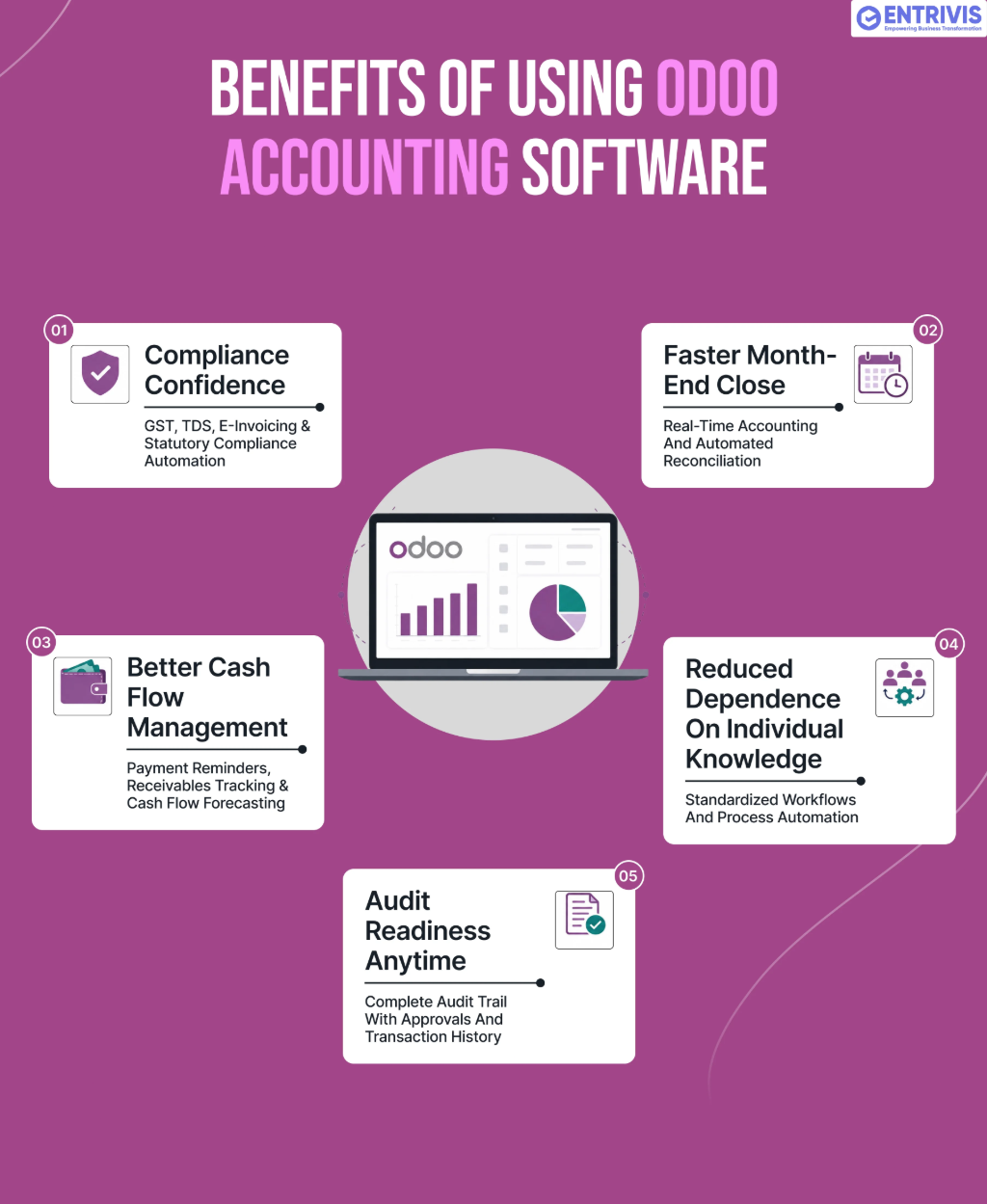
The business case for Odoo accounting software goes beyond efficiency. These are the outcomes that show up in real financial terms.
- Compliance confidence - GST filings, TDS deductions, e-invoicing, and statutory reports are configured into the system, not applied as manual afterthoughts. When compliance is built into your workflow rather than added at period-end, the risk of errors drops substantially, and the stress of tax season becomes manageable.
- Faster month-end close - Businesses that have moved from traditional accounting to Odoo consistently report shorter closing cycles. When transactions are recorded accurately in real time and reconciliation is largely automated, the close becomes a review process rather than a data-gathering exercise.
- Better cash flow management - Automated payment reminders, real-time receivables aging, and cash flow forecasting give your team the visibility to manage working capital proactively, not reactively. Knowing which invoices are overdue and by how much, without pulling a manual report, changes how your team manages collections.
- Reduced dependence on individual knowledge - In a traditional accounting setup, institutional knowledge often lives with specific team members. If your senior accountant leaves, a significant amount of process context leaves with them. A well-configured Odoo accounting system externalizes that knowledge into documented workflows, automated rules, and structured processes that aren't person-dependent.
- Audit readiness at any time - Every transaction in Odoo carries a timestamped audit trail showing who created it, who approved it, and what it was linked to. When an auditor asks for documentation, the answer is a filtered report, not a manual reconstruction of records.
Limitations of Traditional Accounting
It's worth being clear about where traditional accounting systems create genuine operational constraints, not to be dismissive of these tools, but because understanding the limitations is what helps businesses make the right transition decision.
- Period-end dependency - Most traditional accounting processes are designed around monthly or quarterly cycles. The system doesn't show you what's happening today; it shows you what happened last month. For leadership teams that need to manage dynamically, this lag creates a real information gap.
- Manual reconciliation burden - Bank reconciliation, intercompany entries, and GST reconciliation in a manual model all of these require dedicated time and focused attention. As transaction volumes grow, this burden scales linearly with the team, not with technology.
- Integration gaps - A standalone accounting tool doesn't naturally connect to your inventory system, your CRM, or your procurement workflow. That means financial data is always one step behind operational reality, and keeping the two aligned requires manual effort that introduces its own error risk.
- Compliance maintenance complexity - Tax rules change. GST rates are revised. E-invoicing thresholds shift. In a traditional system, these changes require manual updates to calculations, formats, and processes. In Odoo, they're managed through configuration updates that apply across the system automatically.
- Scaling cost - Traditional accounting scales by adding people. More transactions, more team members, more cost. Odoo scales through automation and configuration, so more transactions don't necessarily mean more headcount.
When Should You Switch to Odoo Accounting?
Not every business needs to make this transition immediately, and the timing matters. These are the scenarios where the case for Odoo accounting software becomes compelling.
- Your transaction volume is growing faster than your team can handle - When month-end close takes your finance team the better part of a week, and the problem is volume rather than complexity, automation is the right answer.
- You're managing multiple entities or locations - Consolidated reporting across companies or locations is genuinely difficult in a traditional setup. If your business has reached this stage, a unified platform will save significant effort every reporting cycle.
- GST compliance is consuming disproportionate time - If your team is spending days each month reconciling GSTR-1 with GSTR-2A, or manually preparing e-invoices for each transaction, there's a better way to manage it.
- Your leadership team needs real-time financial visibility - If the answer to "what's our current cash position?" requires someone to compile a report, you're making decisions with a delay built in. Real-time dashboards change that.
- You're planning to raise capital or prepare for a formal audit - Investors and auditors expect clean, traceable financial records. A well-maintained Odoo accounting system provides both with significantly less effort than assembling records from a traditional system under time pressure.
If two or more of these scenarios apply, a conversation with an Odoo implementation services specialist is worth scheduling.
Cost Comparison: Odoo vs. Traditional Accounting
Cost conversations around ERP often focus on the upfront investment and miss the longer-term picture. Here's how it actually breaks down.
- Traditional accounting costs are often underestimated because they're distributed. Software licenses for standalone tools, manual effort costs (hours spent on data entry, reconciliation, and report preparation), error correction costs, and compliance penalty risks. These don't appear as a single line item, but they add up consistently.
- Odoo accounting software involves an upfront investment in implementation and configuration, and an ongoing cost for licensing and Odoo support services. The implementation cost varies based on the scope of your configuration and the complexity of your integrations.
The comparison shifts in Odoo's favor when you factor in the total cost of ownership over three to five years. A business processing significant invoice volumes, managing multiple entities, or carrying a dedicated reconciliation headcount will typically find that the cost of maintaining traditional systems in team time, error correction, and compliance risk exceeds the investment in a modern platform within two years.
For businesses considering ERP migration services from legacy accounting tools, the transition is often less disruptive than expected when managed by an experienced partner.
Final Verdict: Which Is Better for Your Business?
The honest answer is that it depends on where your business is today and where it's heading. For a sole proprietor with a handful of monthly transactions, a traditional accounting tool may be entirely adequate. For a business with growing transaction volumes, multi-entity complexity, compliance obligations, and a leadership team that needs real-time financial data, the traditional model creates constraints that compound over time.
Odoo accounting software is the stronger choice for businesses that are scaling, managing complexity, or simply ready to reclaim the time and attention their finance team currently spends on manual processes. It's not a small upgrade from a spreadsheet; it's a different model of financial management, built for how modern businesses actually operate.
The question isn't really whether Odoo accounting is better. For most growing businesses, it is. The question is when the right time to make the move is,s and who you want to help you make it well. Exploring business automation tools and understanding how they integrate with your accounting function is a good place to start.
FAQs About Odoo Accounting Software
What is Odoo accounting software used for?
Odoo accounting software manages the full range of financial operations, including invoicing, expense tracking, bank reconciliation, tax compliance (including GST and TDS for Indian businesses), financial reporting, and multi-company accounting. It integrates natively with Odoo's other modules, so financial data stays synchronized with your operations in real time.
How is Odoo accounting different from Tally?
Tally is a standalone accounting tool focused primarily on financial record-keeping and statutory compliance. Odoo is a fully integrated ERP platform where accounting is one module within a connected system. The key difference is integration: in Odoo, a confirmed sales order automatically triggers an invoice, updates inventory, and is reflected in your financial reports without manual re-entry. Tally requires data to be entered or imported separately.
Is Odoo accounting software suitable for small businesses?
Yes. Odoo's modular structure means you can start with the accounting module and add others as your business grows. Small businesses benefit from the automation of invoicing, bank reconciliation, and GST compliance, reducing the manual effort that typically consumes disproportionate time in early-stage operations.
Does Odoo support GST compliance for Indian businesses?
Odoo includes India-specific localization for GST covering HSN code mapping, GSTR-1 and GSTR-3B preparation, e-invoicing (IRN generation), and TDS deductions. An experienced Odoo implementation services partner will configure and validate these features for your specific business structure during deployment.
How long does it take to implement Odoo accounting?
Implementation timelines vary based on complexity. A business implementing Odoo accounting as a standalone module with standard configuration can expect a deployment in four to eight weeks. Businesses with multi-company structures, custom reporting requirements, or legacy data migration needs should plan for a longer timeline. An ERP migration services engagement typically includes a detailed project plan with phase-by-phase timelines before work begins.
What kind of support is available after implementation?
Post-implementation support covers bug resolution, performance tuning, Odoo version updates, and ongoing functional assistance. Structured Odoo support services through a retainer model ensure your accounting system stays accurate, compliant, and performant as your business evolves.
Can Odoo accounting integrate with external banking and payment platforms?
Yes. Odoo supports bank feed integration with a wide range of banks, allowing automatic import and matching of bank transactions. Payment gateway integrations for online collections and vendor payment tools can be configured through ERP accounting integration as part of your implementation or as a standalone extension.