Why Subscription Billing Breaks in Service Businesses
Most service businesses do not struggle because they lack customers. They struggle because billing does not scale with growth.
SaaS founders, IT service providers, and digital agencies typically begin with basic invoicing. One client. One invoice. One payment. It works at the beginning. Then the business grows.
More clients. Different plans. Monthly billing. Annual contracts. Upgrades. Downgrades. Renewals. Suddenly, billing becomes a full-time job.
Here is where things usually break:
- Invoices are created manually every month
- Renewals are tracked in spreadsheets or calendars
- Clients change plans, and finance teams adjust bills by hand
- Payments are followed up on via email
- Revenue data is scattered across tools
This leads to:
- Missed invoices
- Late renewals
- Incorrect charges
- Revenue leakage
- Frustrated customers
The biggest issue is visibility. Founders do not know their real recurring revenue. Finance teams often lack confidence in their own numbers. Sales teams promise upgrades that billing systems cannot track cleanly.
Subscription businesses depend on predictability. Manual billing destroys predictability.
This is why service businesses eventually reach a point where billing becomes a bottleneck instead of a support function.
Odoo solves this by turning subscriptions into structured workflows instead of manual tasks. With Odoo subscription billing, invoicing, renewals, and payments are automated inside one system, giving service businesses back control and clarity.
This is where partners like Entrivis Tech add value by designing Odoo around real subscription models, not generic invoicing setups.
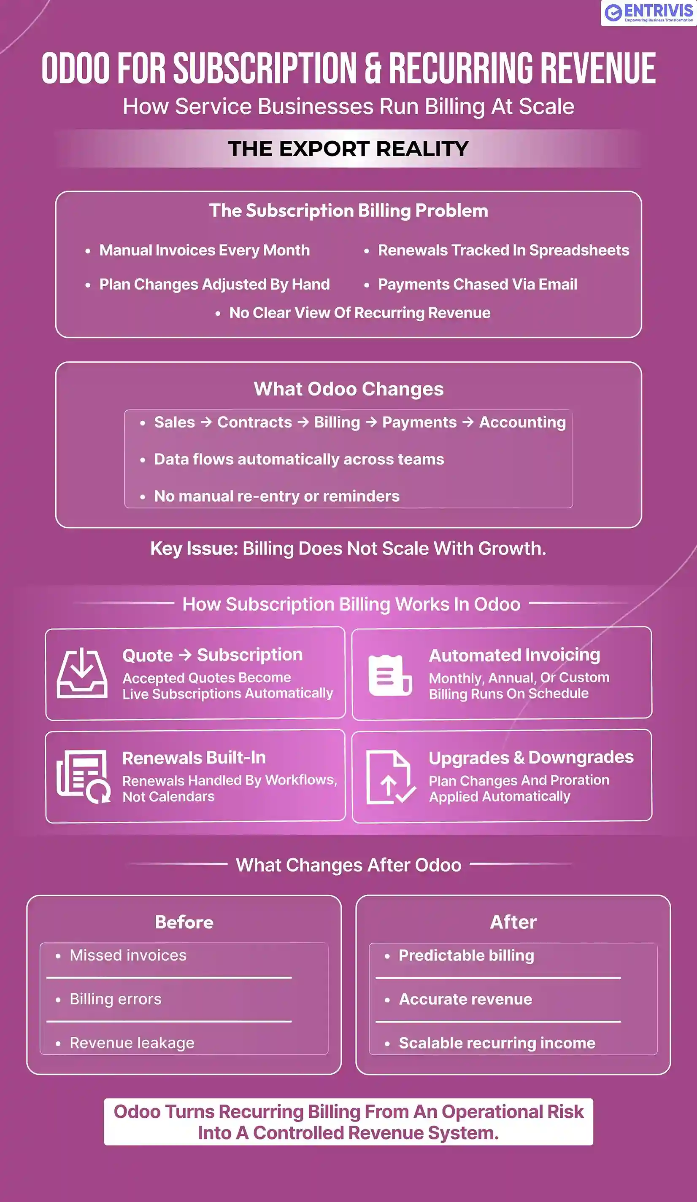
Why Service Businesses Use Odoo for Subscription and Recurring Billing
Service businesses struggle with recurring revenue not because of demand, but because their billing systems fail as complexity grows. As subscriptions increase, contracts evolve, and pricing varies, disconnected tools start creating friction.
Odoo addresses this by treating subscription and recurring billing as a system-wide process, not a standalone invoicing task. Its modular structure connects sales, contracts, billing, payments, and accounting into a single operational flow—keeping recurring revenue predictable as businesses scale.
From first deal to renewal, everything stays connected
In Odoo, subscriptions are managed as structured records rather than isolated invoices. This keeps every commercial and financial detail aligned over time.
Odoo ensures:
- Sales agreements flow directly into active subscription records
- Contract terms remain linked to billing obligations
- Renewals stay visible and traceable
- Customer data remains consistent across teams
This alignment prevents breakdowns between sales, operations, and finance as client relationships evolve.
Billing runs on system logic, not human memory
Manual billing depends on reminders, spreadsheets, and individual follow-ups. That approach becomes unreliable as volume increases.
Odoo replaces memory-based billing with workflow-driven execution, where:
- Billing actions follow predefined subscription rules
- Invoices trigger automatically based on contract terms
- Renewals follow system logic instead of calendar alerts
- Ongoing changes remain controlled and traceable
This shift is critical for service businesses managing recurring clients at scale.
Subscription structures that match how services are actually sold
Service pricing is rarely uniform. Contracts vary by scope, duration, and service mix.
Odoo supports flexible subscription billing structures, allowing businesses to:
- Combine recurring services with one-time charges
- Apply different billing frequencies per contract
- Adjust subscription terms as services evolve
- Reflect real commercial agreements without workarounds
This flexibility allows SaaS companies, IT service providers, and digital agencies to model subscriptions around how they actually sell services.
Recurring revenue that stays accurate in your financials
Recurring billing only works when financial records stay accurate and aligned.
Odoo integrates subscription activity directly with accounting to ensure:
- Invoices match contract terms
- Taxes are applied correctly
- Payments are reconciled automatically
- Revenue reports reflect real recurring income
This gives founders and finance teams confidence in forecasting, reporting, and growth planning, supported by real-time financial control and compliance visibility inside Odoo accounting.
Growth without adding billing overhead
As subscription volume grows, many businesses add staff just to manage billing complexity.
Odoo is designed to scale without increasing administrative load, especially as AI-driven automation and intelligent agents in Odoo reduce manual intervention across billing and operations.
This is the difference between managing billing manually and running a scalable billing system.
Why implementation quality matters
Odoo’s flexibility delivers value only when it mirrors real service operations, which is why an upfront Odoo business study often determines whether subscription billing scales cleanly or breaks later.
Service businesses working with experienced partners like EntrivisTech benefit from subscription workflows designed around:
- Actual contract structures
- Real service delivery models
- Ongoing billing complexity
When implemented correctly, Odoo becomes a reliable recurring revenue foundation, not another system teams work around.
How Subscription Billing Works in Odoo Step by Step
This is the core subscription billing flow in Odoo. Once this process is clear, everything else, automation, renewals, payments, and reporting, falls into place.
Odoo treats subscriptions as structured contracts, not one-off invoices. This design is what makes recurring billing predictable and scalable for service businesses.
Step 1: From quote to subscription without manual setup
The process starts in Sales or CRM.
- A quote is created for a service plan or package
- The quote is linked to a subscription product
- When the customer accepts, a subscription record is created automatically
There is no re-entry of data and no separate setup. The commercial agreement immediately becomes a live subscription contract inside Odoo.
Step 2: Activating the subscription and locking billing rules
Once the quote is confirmed, the subscription is activated.
At this stage:
- The billing cycle is locked
- The subscription start date is set
- Pricing rules are applied
- Renewal logic is defined
From this point onward, Odoo knows when to bill, how much to bill, and when the subscription should renew.
Step 3: Automatic recurring invoice generation
With the subscription active, recurring invoicing runs automatically based on the defined schedule.
For example:
- Monthly subscriptions generate invoices every month
- Annual subscriptions generate one invoice per year
- Custom billing cycles follow the defined pattern
Invoices are generated in the background. Finance teams do not need to remember dates or trigger actions manually.
Step 4: Handling renewals without reminders
When a subscription approaches its end date, Odoo manages renewals as system actions.
The system can:
- Alert the relevant team
- Automatically renew the subscription
- Generate renewal invoices
Renewals stop being calendar reminders and become built-in workflow events.
What does this change mean for service businesses
This structured workflow changes how billing operates day to day.
- Billing becomes predictable
- Sales closes the deal
- Odoo runs the contract
- Finance receives clean invoices
- Customers are billed on time
No chasing. No guessing. No revenue leakage.
This is the foundation of scalable recurring revenue.
Stop Chasing Invoices: How Odoo Automates Recurring Billing
Recurring invoicing is where most service businesses lose time, accuracy, and control. As client volume grows, manual billing processes start creating delays, errors, and revenue leakage.
This section focuses specifically on automating recurring invoicing in Odoo not explaining subscription structure again, but showing how the system removes ongoing billing effort once subscriptions are active.
Let the system handle billing dates and schedules
With Odoo recurring invoicing, billing runs on predefined rules instead of manual triggers.
Odoo supports:
- Monthly billing (set once, repeat automatically)
- Quarterly billing (same logic, different cycle)
- Annual billing (no follow-ups required)
- Custom billing cycles (when standard plans don’t fit)
Each subscription carries its own billing schedule. Invoices are generated automatically on the due date, without finance teams needing to remember, check calendars, or intervene.
Supporting monthly and annual plans without extra work
Many service businesses offer a mix of monthly and annual subscriptions. Managing these manually often leads to tracking issues.
Odoo handles mixed billing models cleanly:
- Monthly plans generate twelve invoices per year automatically
- Annual plans generate a single invoice per year
- One-time setup fees can be billed separately or alongside subscriptions
There is no need to manage different billing models in spreadsheets or external tools. The system applies the correct logic for each plan consistently.
Handling mid-cycle changes without manual calculations
Proration is one of the most common sources of billing errors and client disputes.
When a customer starts mid-cycle, upgrades a plan, or changes scope, Odoo automatically applies proration rules at the system level. This ensures:
- Clients are billed only for what they use
- Overcharging and undercharging are avoided
- Manual adjustments are eliminated
By handling proration automatically, Odoo protects both revenue accuracy and customer trust.
What automated recurring invoicing changes
When recurring invoicing is automated correctly:
- Billing runs in the background
- Finance teams stop managing schedules
- Errors and disputes drop significantly
- Revenue becomes more predictable
This sets the foundation for managing renewals, upgrades, and changes without breaking billing, covered in the next section.
Managing Renewals, Upgrades, and Downgrades Without Billing Breakage
Subscriptions do not stay the same over time. Clients upgrade, downgrade, pause services, or change scope. For many service businesses, this is where billing errors, disputes, and revenue leakage begin.
Odoo is designed to handle subscription changes as part of the system, not as exceptions. Renewals, plan changes, and contract updates are applied directly to the subscription record, so billing stays accurate even as agreements evolve.
Renewals that run as system workflows, not reminders
Manual renewal tracking depends on calendars, spreadsheets, and follow-ups. That approach breaks as subscription volume grows.
Odoo turns renewals into system-driven actions:
- Subscriptions can renew automatically based on contract rules
- Teams receive alerts before expiry when review is needed
- Renewal invoices are generated without manual intervention
Renewals stop being something teams remember to do and become something the system handles consistently.
Handling upgrades and downgrades without recalculations
Plan changes are common in growing service relationships. They are also a frequent source of billing mistakes.
When a client upgrades or downgrades, Odoo:
- Adjusts subscription pricing automatically
- Applies proration when required
- Updates upcoming invoices to reflect the new plan
Future invoices always match the current agreement. There is no need for manual recalculation, credit notes, or billing corrections.
Contract changes that do not create billing errors
Service contracts often change beyond pricing. Scope, users, or service levels may shift over time.
Odoo reflects these changes directly within the subscription record, ensuring:
- Billing aligns with the latest contract terms
- Changes apply cleanly to future invoices
- Historical billing remains traceable
This is especially important for IT service providers and digital agencies, where scope adjustments are frequent, and billing accuracy directly affects client trust.
What this means for service businesses
When renewals and plan changes are handled inside the subscription system:
- Billing stays accurate as contracts evolve
- Revenue leakage from missed or incorrect invoices is reduced
- Finance teams stop firefighting billing issues
- Client conversations focus on value, not corrections
This level of control is essential for scaling recurring revenue without increasing operational risk.
Handling Payments and Failed Charges in Odoo
Billing only matters if payments are actually collected. For many service businesses, invoices go out on time, but payments do not come in without follow-ups, reminders, or uncomfortable client conversations.
Odoo connects subscription billing directly with payment processing so that collections happen as part of the system, not as a separate manual task.
Accepting payments without friction for customers
Odoo integrates with major payment providers, allowing service businesses to collect payments the way customers expect.
This enables:
- Online payments through customer portals
- Automatic charging for active subscriptions
- Secure storage of payment tokens for recurring use
Customers can pay invoices themselves or be charged automatically based on the subscription terms. Payments stop being a bottleneck and become part of the subscription flow.
Automatic charging for subscription-based services
For recurring services, manual payment collection does not scale.
Odoo supports automatic charging by securely storing payment tokens and charging customers on the invoice date. This is especially important for SaaS businesses, managed services, and retainers where predictable cash flow is essential.
Automatic charging reduces:
- Late payments
- Missed invoices
- Manual follow-ups from finance teams
Managing failed payments without revenue leakage
Failed payments are inevitable. What matters is how they are handled.
When a payment fails, Odoo can:
- Flag the unpaid invoice immediately
- Notify the internal team or the customer
- Retry the payment automatically based on defined rules
- Restrict services when required
Instead of discovering failures weeks later, teams get immediate visibility and system-driven responses. This significantly reduces revenue leakage and protects cash flow.
What does this change mean for service businesses
When payments are integrated directly into the subscription system:
- Collections become predictable
- Finance teams spend less time chasing payments
- Failed charges are handled consistently
- Cash flow improves without adding pressure on clients
This creates a clean transition into tracking recurring revenue, churn, and financial performance.
Tracking Recurring Revenue and Subscription Metrics in Odoo
Recurring revenue only works when it is visible. Without clear metrics, growth feels unpredictable, and decisions rely on assumptions instead of data.
Odoo gives service businesses real-time visibility into subscription performance by tracking recurring revenue directly from active contracts, billing activity, and payments. This turns recurring revenue from theory into something measurable and controllable.
Seeing predictable income with MRR and ARR
Understanding recurring revenue starts with knowing how much income is expected.
Odoo tracks monthly recurring revenue and annual recurring revenue directly from active subscriptions, enabling AI-driven financial insights for CFO decision-making.
Because these metrics are generated directly from live subscription data, founders can see predictable income instead of estimating it manually or relying on spreadsheets.
This creates confidence in planning, hiring, and growth decisions.
Identifying churn before it becomes a problem
Churn is one of the most important signals in a subscription business.
When a subscription is cancelled, Odoo records churn automatically. This allows businesses to identify:
- Client retention issues
- Service delivery problems
- Pricing or packaging gaps
Instead of discovering churn after revenue drops, teams can see patterns early and take corrective action.
Understanding real growth through expansion and contraction
Not all growth comes from new clients. Existing customers often expand or reduce their subscriptions over time.
Odoo tracks:
- Expansion revenue from upgrades or added services
- Contract revenue from downgrades or reduced scope
This gives a more accurate picture of business health by showing whether growth is coming from new sales, existing clients, or both.
Dashboards that give founders clear control
Raw data is only useful when it is easy to interpret.
Odoo dashboards provide a clear overview of:
- Active subscriptions
- Upcoming renewals
- Expected recurring revenue
- Payment and invoice status
This gives founders and leadership teams a single view of subscription health without pulling data from multiple tools.
What does this visibility change for service businesses
When subscription metrics are visible in real time:
- Revenue forecasting becomes reliable
- Problems are identified earlier
- Decisions are based on facts, not assumptions
- Leadership gains control over recurring income
This level of visibility is essential for scaling a subscription-based service business with confidence.
Real Service Business Use Cases
SaaS company billing model
A SaaS startup sells monthly and annual plans. Sales closes the deal. Odoo creates the subscription. Invoices are generated automatically. Payments are charged without manual follow-up. Renewals are handled by the system.
Result
Clean revenue flow without finance overload.
IT services retainer model
An IT services firm runs support contracts. Odoo bills clients every month, tracks scope changes, and applies proration when plans change.
Result
No missed invoices. No billing disputes.
Digital agency monthly packages
A digital agency offers SEO and marketing retainers. Odoo handles monthly billing, upgrades for additional services, and renewal tracking.
Result
Predictable income and fewer client conversations about billing errors.
Common Billing Problems Odoo Eliminates
Most billing problems in service businesses are not caused by bad intent or poor teams. They happen because billing relies on manual processes, disconnected tools, and human memory.
As subscription volume grows, these issues become harder to detect and more expensive to fix.
Odoo replaces fragile billing processes with structured, system-driven workflows.
The problems service businesses face
Without a centralized subscription system, teams commonly deal with:
- Missed invoices caused by manual billing schedules or forgotten actions
- Forgotten renewals tracked in calendars or spreadsheets
- Incorrect charges after plan upgrades, downgrades, or scope changes
- Revenue leakage from failed payments that are not followed up
- Lack of visibility into which contracts are active, expiring, or unpaid
These issues rarely show up immediately. They quietly compound over time.
How structure replaces chaos
Odoo eliminates these problems by enforcing billing logic at the system level.
Instead of relying on reminders and manual checks:
- Subscriptions drive billing automatically
- Renewals follow defined rules
- Contract changes update future invoices
- Payments and failures are tracked centrally
- Revenue data stays consistent across teams
Billing stops depending on individual effort and starts running as part of the business system.
What this means in practice
When billing problems are removed at the root:
- Fewer disputes with clients
- More predictable cash flow
- Less time spent correcting invoices
- Greater confidence in revenue numbers
This shift from reactive fixes to structured controls enables service businesses to scale recurring revenue without losing visibility or trust.
When Subscription Businesses Need Customization in Odoo
Not all subscription models follow a simple, fixed pricing model. As service businesses grow, billing structures often become more complex, and generic setups start to fall short.
Customization becomes necessary when subscriptions no longer fit standard templates, especially when evaluating standard Odoo features versus custom development.
Situations where standard billing setups break down
Service businesses typically need customization when:
- Pricing is usage-based or variable
- Multiple services are bundled differently for each client
- Tax rules differ across countries or regions
- More than one legal entity bills the same customer
These scenarios are common in SaaS, IT services, and agencies operating at scale. Without proper configuration, they often lead to billing errors, manual workarounds, or reporting gaps.
What customization is enabled in Odoo
Odoo is designed to adapt to complex subscription models instead of forcing businesses into rigid structures.
With the right configuration, Odoo can support:
- Complex pricing and billing logic
- Approval flows for non-standard contracts
- Multi-entity and intercompany billing
- Industry-specific compliance and operational rules
Customization allows the system to reflect how the business actually operates, not how software assumes it should.
Why implementation expertise matters here
Customization is not about adding complexity. It is about removing friction.
Odoo Implementation partners like Entrivis Tech design subscription workflows around real service operations, contract structures, and billing realities. This prevents teams from relying on workarounds and keeps billing scalable as complexity grows.
When customization is done correctly, Odoo remains stable, auditable, and easy to operate even as subscription models evolve.
What this means for growing service businesses
Customization ensures that:
- Billing accuracy is maintained as complexity increases
- Finance teams trust the numbers they see
- Operations scale without constant manual intervention
- The system supports growth instead of slowing it down
This is how Odoo continues to work as a long-term subscription platform rather than a short-term fix.
Is Odoo Right for Your Subscription Business
The table below helps you quickly assess whether Odoo fits your billing and subscription complexity.
If this describes your business | Odoo is likely a strong fit |
You run monthly or annual subscription billing | Yes |
You manage many active clients or contracts | Yes |
You offer multiple plans, retainers, or service tiers | Yes |
Clients upgrade, downgrade, or change scope | Yes |
Renewals and follow-ups are hard to track | Yes |
You need clear visibility into recurring revenue | Yes |
If this describes your business | Odoo may be more than you need |
You invoice only occasionally | Likely not |
You have very few long-term clients | Likely not |
Your billing model is fixed and rarely changes | Likely not |
You do not need detailed revenue tracking | Likely not |
The real deciding factor
The decision is not about company size. It is about billing complexity.
If subscriptions involve renewals, plan changes, payments, and reporting across multiple clients, Odoo provides the structure needed to stay accurate and predictable. If billing is simple and infrequent, lighter tools can be sufficient.
Final Takeaway
Recurring revenue businesses survive on predictability. Manual billing removes that predictability by introducing delays, errors, and blind spots.
Odoo replaces fragile billing practices such as:
- Spreadsheets
- Manual invoicing
- Calendar-based renewals
- Follow-up driven collections
With a structured system built on:
- Automated subscription billing
- System-driven renewals and plan changes
- Real-time recurring revenue visibility
- Integrated payment handling
For SaaS founders, IT service providers, and digital agencies, this is not a feature upgrade. It is a shift in how revenue is controlled and scaled.
When Odoo is implemented correctly by experienced specialists, subscription billing stops being an operational risk, often starting with a structured Odoo system audit to align contracts, billing logic, and financial controls.
Service businesses also need clear guidance to design subscription workflows that scale without breaking billing accuracy, which is where Odoo consulting focused on real subscription and service models becomes a natural next step.
That is how service businesses grow recurring revenue without losing control, accuracy, or confidence.
Frequently Asked Questions
Can Odoo generate recurring invoices automatically
Yes. Odoo generates invoices based on the defined schedule without manual action.
Does Odoo handle subscription renewals
Yes. Renewals can be automated or triggered with alerts.
Can Odoo manage upgrades and downgrades
Yes. Plan changes are reflected in billing automatically with proration.
Can Odoo track MRR and churn
Yes. Odoo provides dashboards and reports for recurring revenue metrics.
Does Odoo integrate with payment gateways
Yes. Odoo supports online payments and automatic charging.