Your ERP system runs your business. When it slows down, so does everything else: purchase orders pile up, reports take too long to generate, and your team starts working around the system instead of through it. And somewhere in that friction, revenue quietly leaks.
Odoo ERP support is what keeps that from happening. Not as a reactive fix when something breaks, but as an ongoing discipline that keeps your system performing, scaling, and staying aligned with how your business actually operates.
This guide is for business owners, operations heads, and finance leaders who want to understand what good ERP support looks like and how to make it work for their organization.
Why ERP Performance Matters More Than Ever
A slow ERP isn't just an IT problem. It's a business problem.
When your inventory reports take four minutes to load, your procurement team makes decisions on stale data. When your billing module throws an error during month-end close, your finance team loses hours tracing it manually. When a new branch goes live, and system performance degrades across the board, your leadership team starts questioning the entire platform.
These aren't hypothetical scenarios. They're patterns that emerge when businesses grow faster than their ERP configuration keeps up with. And they're entirely preventable with the right Odoo ERP support structure in place.
The businesses that get the most out of Odoo are the ones that treat ERP performance as an ongoing investment, not a one-time project. They don't wait for something to break. They build a support relationship that keeps the system ahead of the business, not chasing it.
What Is Odoo ERP Support and Why It's Critical
Odoo support services cover everything that happens to your Odoo system after go-live. That's a broader scope than most businesses initially expect.
At the foundational level, support means resolving issues: bugs, errors, unexpected behavior in modules, and performance degradation. But that's only one layer. A well-structured support engagement also covers system maintenance routine tasks that keep Odoo running cleanly over time. It includes performance tuning, ensuring your system handles growing data volumes and user loads without slowing down. It covers version upgrades, applying Odoo's regular releases without disrupting your operations. And it includes security patches, making sure your system isn't exposed to vulnerabilities that emerge after deployment.
Think of it this way: implementing Odoo is like setting up a well-designed office. Support is what keeps that office organized, functional, and ready to accommodate a larger team as the business grows. Without it, things gradually drift and eventually, what was a productive environment becomes a source of friction.
For businesses running core operations on Odoo - finance, inventory, procurement, manufacturing, HR, that friction is expensive. Reliable Odoo support services are what prevent it.
Signs Your Business Needs Odoo Support Services
Most businesses don't recognize the need for structured support until a problem has already been affecting them for weeks. These are the signals worth paying attention to early.
- Reports are slow to generate - If your monthly P&L or inventory valuation report takes noticeably longer than it used to, your database likely needs optimization. Data accumulates, tables grow, and without regular maintenance, query performance degrades.
- Your team is reporting recurring errors - A module that occasionally throws an error isn't a minor inconvenience; it's a warning that something in your configuration or code isn't handling a specific condition properly. Left unresolved, these errors tend to escalate.
- System performance drops during peak hours - If Odoo slows down when multiple users are active simultaneously, your server configuration or database indexing may need attention. This becomes especially pronounced as your team grows.
- You've added new operations but haven't updated your system - A new warehouse, a new product category, a new entity - each of these changes how Odoo needs to be configured. Running new operations on an unchanged system creates mismatches that compound over time.
- You're running an older version of Odoo - If your business is still on Odoo 14 or 15 while the platform has moved ahead, you're missing security updates, performance improvements, and new features that your competitors may already be using.
Any one of these signals warrants a conversation with an Odoo support specialist. Two or more together suggest the need for a structured support engagement.
What Does an Odoo Support Specialist Actually Do?
The term "support" undersells what a skilled Odoo support specialist actually contributes. Here's what the role looks like in practice, broken into the areas that matter most to your business.
Technical Support & Issue Resolution
When something goes wrong in Odoo, the diagnostic work begins immediately. An Odoo ERP support specialist traces the issue to its root, whether that's a misconfigured workflow, a code error in a custom module, a database inconsistency, or a server-side resource issue.
The difference between good and average support at this level is speed and accuracy. A specialist who understands Odoo's architecture can identify the source of an error in minutes rather than hours. They also know how to resolve it without inadvertently affecting other parts of the system, which is a real risk when fixes are applied without a proper understanding of downstream dependencies.
Server issues, scheduled job failures, integration errors with third-party systems, all of these fall within this scope. You get resolution, documentation of what caused the issue, and ideally a recommendation to prevent recurrence.
Performance Optimization & Scaling
A system that performed well at 20 users and 50,000 records may start showing strain at 80 users and 500,000 records. That's not a sign that Odoo isn't capable; it's a sign that the system needs to be tuned for where your business is now, not where it was at go-live.
An Odoo support specialist working on performance optimization looks at database indexing, query efficiency, server resource allocation, and caching configurations. They identify which reports or processes are consuming disproportionate resources and restructure them to run more efficiently.
For businesses adding new locations, products, or business units, proactive scaling work ensures that growth doesn't come with a corresponding drop in system performance. The goal is an Odoo that runs faster next year than it does today because someone is actively managing it.
Continuous Updates & Security
Odoo releases updates regularly, bug fixes, security patches, and new version releases. Each of these needs to be evaluated, tested, and applied in a controlled way. Applying an update without testing in a staging environment first is a risk no business should take with a live production system.
Structured Odoo support services include a managed update process: updates are reviewed for relevance, tested against your specific configuration, and applied during a planned window that minimizes disruption. Security patches, in particular, are prioritized because an unpatched system is an exposed one, and the consequences of a security breach in an ERP that holds your financial and operational data are significant.
For businesses with compliance obligations, staying current with Odoo's India localization updates, GST rule changes, and e-invoicing format revisions is also part of this ongoing responsibility.
Key Benefits of Investing in Odoo ERP Support
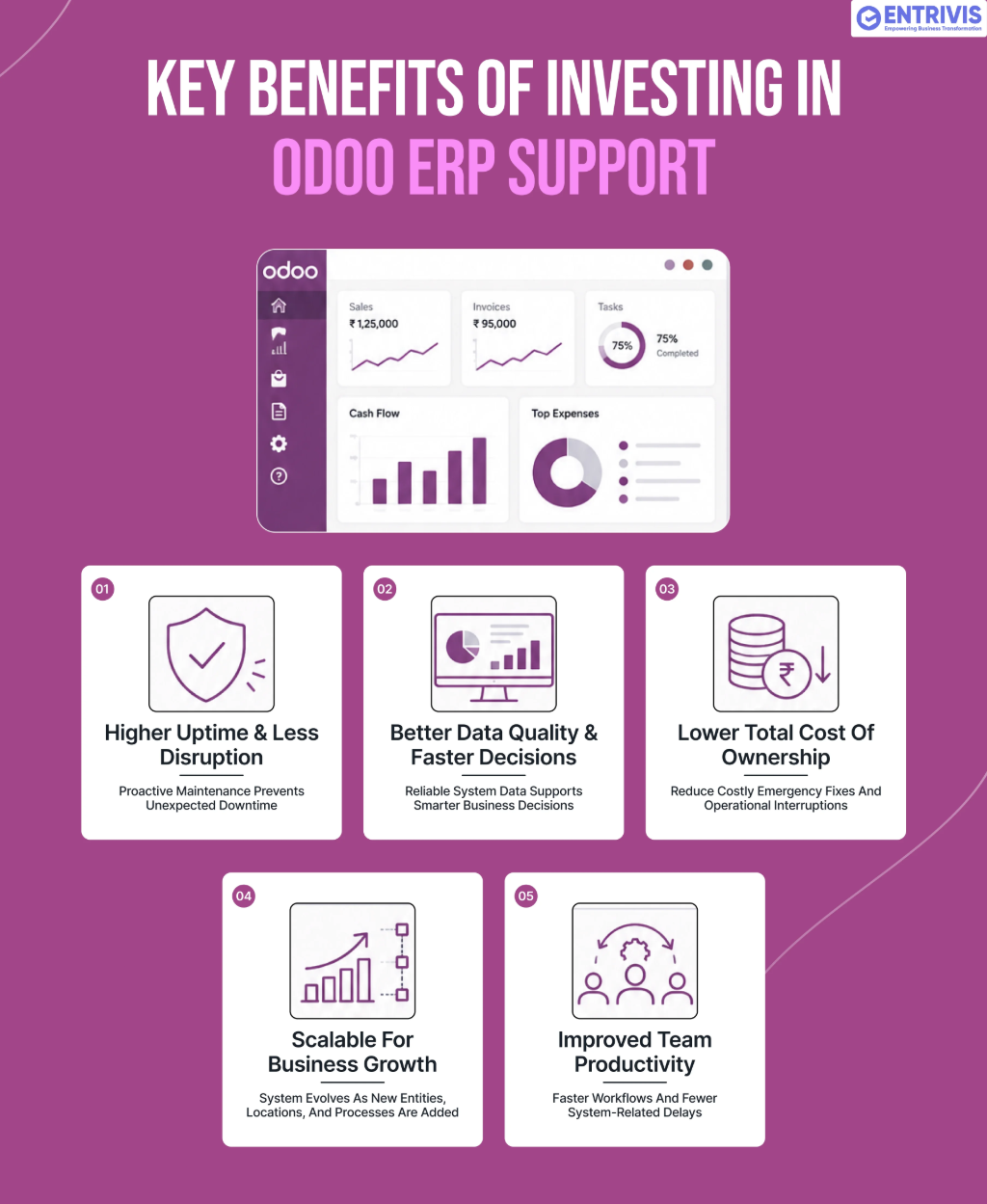
The return on structured Odoo ERP support shows up in places that matter to business outcomes, not just IT metrics.
- Higher uptime, lower operational disruption - Proactive maintenance catches issues before they become outages. A business running on a well-supported Odoo instance experiences far fewer unplanned disruptions than one managing the system reactively.
- Better data quality, faster decisions - A system that runs cleanly produces reliable data. When your team trusts the numbers in Odoo, they use the system more consistently, which improves data quality further. That cycle of trust and accuracy is the foundation of data-driven decision-making.
- Lower total cost of ownership - Emergency fixes are expensive in time, in consultant fees, and in the business cost of downtime. Regular, structured support is almost always cheaper than the accumulated cost of reactive problem-solving.
- A system that scales with your growth - A supported system is maintained, one that's actively configured to handle your business as it grows, not as it was when you went live. That means fewer surprises when you add a new entity, open a new location, or launch a new product line.
- Your team stays productive - Every hour your team spends working around a broken workflow or waiting for a slow report is an hour not spent on the work that moves your business forward. Good support protects that productivity.
Common ERP Performance Challenges (and How Support Solves Them)
These are the performance issues businesses most commonly face after go-live, and what structured Odoo support services do to address them.
Challenge | What's Happening | How Support Resolves It |
Slow report generation | Database tables are large and unoptimized; queries are inefficient | Database indexing, query optimization, and archiving old records |
Module errors during peak use | Configuration gaps or code issues triggered under load | Root cause diagnosis, bug fix, regression testing |
Integration failures | Third-party connectors breaking due to API changes or config drift | Integration audit, connector update, error handling improvement |
User adoption dropping | System feels cumbersome; workflows don't match actual processes | UX review, workflow reconfiguration, targeted retraining |
Security vulnerabilities | Running an outdated version with known exposures | Managed patch application and version upgrade planning |
Data inconsistencies | Records are not reconciling across modules | Data audit, reconciliation scripts, and configuration correction |
Performance under growing user load | Server resources not scaled to current usage levels | Server assessment, resource scaling, and caching configuration |
Each of these has a clear resolution path, but only if someone is monitoring for them and equipped to act when they appear.
In-House vs. Outsourced Odoo Support: What's Better?
This is a question worth thinking through carefully, because the right answer depends on your business size, budget, and how central Odoo is to your operations.
- In-house support means hiring one or more Odoo-certified developers or functional consultants as employees. The advantage is dedicated availability and deep familiarity with your specific configuration. The challenge is that a skilled Odoo developer commands a competitive salary and coverage gaps during leave, attrition, or when an issue requires specialized expertise your in-house team doesn't have.
- Outsourced support from a specialist Odoo support specialist or firm gives you access to a broader team of multiple certified professionals with experience across industries and Odoo versions at a predictable monthly cost. Coverage is more consistent, and the depth of expertise available is typically greater than what a single in-house hire can provide.
For most MSMEs and mid-market businesses, outsourced support through a structured retainer model delivers better value per rupee than a comparable in-house team. The calculus shifts for large enterprises with complex, highly customized Odoo environments where on-site, embedded support becomes more justifiable.
A hybrid approach also works well: an internal Odoo champion who handles day-to-day functional queries, backed by an external support partner who handles technical issues, upgrades, and performance work. This gives you responsiveness and depth without the full cost of an in-house team.
How to Choose the Right Odoo Support Partner
Not all support engagements are created equal. Use this checklist when evaluating an Odoo ERP support partner.
- Response time commitments - What are their SLAs for critical issues versus standard queries? Is the response time guaranteed in writing?
- Certified resources - Do they have Odoo-certified technical and functional consultants on staff, not just developers with general Python experience?
- Version expertise - Are they actively working with the Odoo version your business is running? Have they handled upgrades between major versions?
- Proactive vs. reactive posture - Do they only respond to tickets, or do they also monitor system health and flag issues before they escalate?
- India localization knowledge - If your business is in India, do they have documented experience with GST, e-invoicing, TDS, and statutory reporting in Odoo?
- Documentation practices - Do they document every fix and change, so your system history is preserved regardless of which team member is involved?
- Escalation path - When a complex issue arises, who handles it, and how quickly can a senior resource be engaged?
- Transparent reporting - Do they provide regular summaries of support activity, open issues, and system health indicators?
A partner who checks all of these boxes treats your ERP as seriously as you do.
If you also want an Odoo ERP developer and you don’t know how to hire one, you can check How to Hire Odoo Developers: Expert Guide by Entrivis Tech
Best Practices to Maximize ERP Performance
Good Odoo support services aren't just about fixing problems; they're about preventing them. These practices keep your system performing at its best over time.
- Schedule regular system audits - A quarterly review of your Odoo configuration, custom modules, and integration health catches drift before it becomes a problem. Workflows change, teams grow, and the system needs to be checked against current reality periodically.
- Archive and clean your database regularly - Transaction records, log files, email attachments, and temporary data accumulate over time. A bloated database is a slow database. Scheduled archiving keeps query performance sharp without losing historical data you may need.
- Use a staging environment for all changes - Whether you're applying an update, modifying a workflow, or testing a new module, changes should be validated in a staging environment before touching production. This one practice prevents a significant percentage of go-live-related incidents.
- Monitor system performance proactively - Server resource utilization, slow query logs, and scheduled job completion times are early warning systems. Reviewing these regularly rather than waiting for users to report problems gives your support team time to act before performance visibly degrades.
- Keep your integrations documented and reviewed - Third-party integrations are common points of failure as APIs change and configurations drift. An annual review of all active integrations ensures they're still functioning as intended and using current authentication methods.
- Train new users properly - Many performance issues are actually usage issues, such as users running reports incorrectly, creating duplicate records, or triggering workflows unintentionally. Structured onboarding for new team members reduces system noise and improves data quality.
Final Thoughts: Turning ERP into a Growth Engine
Odoo ERP support isn't a defensive investment; it's a growth investment. When your system runs cleanly, your team works confidently. When performance is maintained proactively, your operations scale without friction. When issues are resolved quickly and thoroughly, the trust your organization has in its data stays intact.
The businesses that extract the most value from Odoo are the ones that never stop investing in it. They treat their ERP as a living system that needs ongoing attention, not a project with a finish line.
If your Odoo system is underperforming, or if you're looking to build a support structure that keeps pace with your growth, the conversation is worth having before the next issue surfaces.
At Entrivis Tech, our support engagements are built around your business's proactive monitoring, certified resources, India-specific expertise, and a team that treats your ERP with the same care we'd want for our own. Less firefighting, more forward progress.
Connect with Entrivis Tech for a free Odoo support consultation