If you've been running your business on a patchwork of disconnected tools, one for accounts, another for inventory, a third for HR, you already know the cost of that complexity. Lost time. Data that doesn't sync. Teams working in silos.
That's exactly why demand for Odoo development services has surged. Odoo has crossed 12 million users worldwide, and adoption continues to accelerate as more companies prioritize ERP consolidation. The reason is simple: one integrated platform, lower overhead, and a team of developers who know every corner of it.
In 2026, hiring an Odoo developer isn't just a technical decision; it's a business decision. The right developer can reduce operational costs, speed up delivery cycles, and give you a cleaner view of your business in real time. The wrong hire or worse, no hire at all, keeps you stuck.
This guide walks you through everything you need to know: what to look for, how to hire, what it costs, and how to get started in as little as 48 hours.
What Makes Odoo the Preferred ERP in 2026?
You've probably come across SAP and Oracle. Both are powerful. Both are also expensive, rigid, and built for enterprises with the budget and patience to match.
Odoo takes a different approach, and that's what makes it the go-to choice for growing businesses.
- Modular by design - You don't buy Odoo as one massive system. You start with what you need to say, accounting and CRM, and add inventory, project management, or manufacturing as your business evolves. No forced upgrades, no paying for features you don't use.
- Built to scale - Whether you're a 20-person team or a 2,000-person enterprise, Odoo's architecture scales without requiring a platform switch. The foundation you set up today can grow with you.
- Significantly more cost-efficient - Compared to SAP or Oracle, Odoo's licensing and implementation costs are a fraction of the price without sacrificing functionality. For MSMEs in particular, this changes the economics of ERP entirely.
- Open-source core, enterprise reliability - Odoo's open-source foundation means extensive community support, regular updates, and the flexibility to customize without vendor lock-in.
If you're evaluating ERP options, the question isn't whether Odoo can handle your business; it's whether you have the right Odoo ERP implementation partner to configure it properly.
Why Hire Odoo Developers Instead of Building an In-House Team?
This is a question many operations heads and CTOs ask early on. The honest answer: it depends on your needs, but for most businesses, hiring a dedicated Odoo developer (or team) makes more practical sense than building in-house from scratch.
Here's why:
- Faster time to value - Building an in-house team takes months of recruiting, onboarding, and training on Odoo's framework. A dedicated developer can start contributing within days, not quarters.
- Access to specialized expertise - Odoo has 45+ modules and a specific development framework. A developer who has spent years in the Odoo ecosystem simply knows more edge cases, best practices, and pitfalls than someone new to the platform.
- Cost flexibility - Hiring in-house means salaries, benefits, office space, and the risk of overstaffing during slower periods. With a dedicated or contracted Odoo developer, you pay for what you need, when you need it.
- No knowledge drain - When an in-house Odoo specialist leaves, they often take critical institutional knowledge with them. A development company provides continuity with the same team, ongoing support, and documented code.
- Scalability - Need to ramp up for a major implementation? Scale down after go-live? A flexible engagement model lets you adjust without HR headaches.
Consider a mid-sized manufacturing company that needed to connect its supply chain, warehouse, and accounting into one system. Rather than spending 6–8 months hiring internally, they engaged a dedicated Odoo developer and went live in 10 weeks. That's the kind of impact the right hire can make.
Types of Odoo Developers You Can Hire
Not every project needs the same type of engagement. Here's a clear breakdown so you can match the right model to your situation.
Dedicated Odoo Developers
A dedicated developer works exclusively on your project full-time, aligned with your team, and focused entirely on your goals. This model works best for long-term projects where continuity matters: large-scale custom Odoo solutions, phased rollouts, or businesses that need ongoing development alongside day-to-day operations.
The advantage here is control. You direct the work, set the priorities, and get someone who genuinely understands your business, not just the technical specs. Over time, that familiarity pays off in better decisions, faster turnarounds, and less back-and-forth.
If you're running a growing business and Odoo is going to be your operational backbone, a dedicated developer (or dedicated team) is typically the most effective long-term investment.
Odoo Certified Developers
Certification from Odoo S.A. isn't just a credential on a CV; it's a marker of verified technical competence. An Odoo-certified developer has passed standardized assessments covering both functional knowledge and development best practices.
In practical terms, this means fewer surprises. Certified developers follow Odoo's recommended architecture, write code that's upgrade-compatible, and understand the platform's security model. When you hire certified, you're buying quality assurance built into the process, not just a promise.
At Entrivis Tech, our development team is Odoo-certified and regularly updated on new releases. You're not getting someone who learned Odoo six months ago.
Freelance Odoo Developers
Freelancers can be the right fit for short, well-defined tasks, a single module fix, a quick customization, or a specific integration. The trade-off is availability, accountability, and the risk of inconsistent quality. Without a team backing them, freelancers are vulnerable to bandwidth issues, and project ownership can become fuzzy.
For anything beyond a small, contained task, a structured engagement with an Odoo development company typically delivers better outcomes.
In-House Odoo Teams
Building internally makes sense if Odoo is central to your product or if you need full-time, on-premise availability. The caveat: recruitment is slow, training takes time, and retaining experienced Odoo talent is competitive. Most companies find that a hybrid model, a trusted external partner for development, internal staff for daily operations, gives them the best of both worlds.
Key Benefits of Hiring an Odoo Development Company
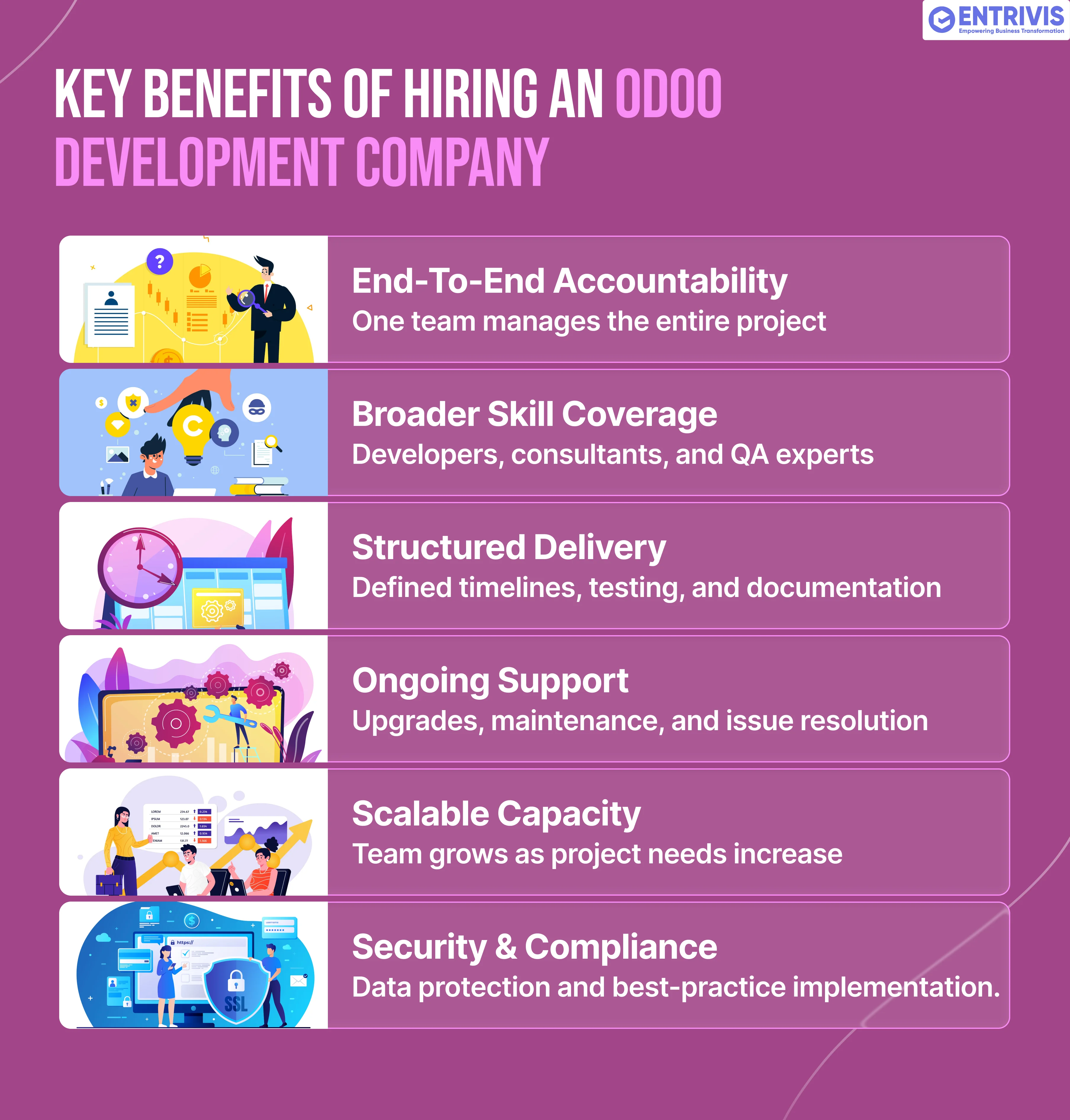
Working with a dedicated Odoo development company rather than individual contractors gives you a different kind of confidence.
- End-to-end accountability - From requirement gathering to deployment and post-go-live support, one team owns the entire process. There's no hand-off risk, no "that's not my scope" conversations.
- Broader skill coverage - A company brings functional consultants, backend developers, frontend specialists, and QA engineers, all familiar with Odoo. A single freelancer can't offer that range.
- Structured delivery - Project timelines, documentation, code reviews, testing protocols, these exist as part of how a professional company operates, not as extras you have to negotiate for.
- Ongoing support - After go-live, things will need attention. New modules, version upgrades, and user issues. A development company is still there. A freelancer may not be.
- Scalable capacity - When your project grows, so can the team. You're not limited to one person's bandwidth.
- Regulatory and data compliance - A reputable company will implement Odoo with data security, access controls, and compliance best practices built in.
Our Odoo Development Services
At Entrivis Tech, we cover the full spectrum of Odoo development from first-time implementations to complex integrations and long-term support. Here's how we typically work with clients:
Odoo Customization
No two businesses run the same way. Out-of-the-box Odoo is a strong foundation, but most companies need modules tailored to their workflows, approval chains, reporting formats, or industry-specific requirements.
Our team handles custom Odoo solutions from simple field additions to entirely new modules built on Odoo's framework. Every customization is built to be upgrade-compatible, so you're not locked into a version forever.
Real-world scenario: A logistics company needed custom route optimization integrated into Odoo's inventory module. We built a bespoke module that updated delivery sequences automatically, reducing manual dispatch time by over 60%.
Odoo Integration
Odoo rarely lives in isolation. Most businesses need it connected to external tools: payment gateways, e-commerce platforms, third-party CRMs, accounting software, shipping providers, or industry-specific systems.
Our CRM integration services and API integration work ensure your Odoo instance talks cleanly to the rest of your tech stack, bidirectional data sync, no duplicate entries, and no manual exports.
Odoo Migration
Already on an older Odoo version or migrating from a completely different ERP? Version upgrades require careful data mapping, module compatibility checks, and thorough testing before going live. Skipping steps here is where most migrations go wrong.
Our Odoo ERP migration process is structured: audit your current setup, map data to the new schema, run parallel testing, and migrate with minimal downtime. We've handled migrations from Odoo 12 through to Odoo 17, as well as migrations from platforms like Tally, SAP Business One, and custom-built systems.
Odoo Support & Maintenance
Going live is step one. What happens after is just as important. Systems evolve, users encounter issues, and new requirements emerge. Our Odoo ERP support team is available for ongoing functional guidance, bug resolution, performance optimization, and module updates.
Think of it as having a technical team on call without the overhead of keeping them full-time on payroll.
How to Hire Odoo Developers in 48 Hours (Step-by-Step)
Here's how the process works when you engage Entrivis Tech:
- Share your requirements - Tell us about your project: what you're building, what your current setup looks like, and what timeline you're working toward. A quick call or a detailed brief either works.
- We shortlist the right profiles - Based on your scope, we match you with developers from our certified team who have relevant experience, not just whoever's available.
- Meet the developers - You interview the proposed profiles. Ask technical questions, discuss your workflows, and get a feel for the fit. We're not rushing you past this step.
- Finalize and onboard - Once you're satisfied, we handle the contract and onboarding. Most clients are up and running within 48 hours of final confirmation.
No lengthy procurement process. No weeks-long recruitment cycle. Just a straightforward path from "I need an Odoo developer" to "we've started work."
Why Choose Our Odoo Developers?
There are plenty of development companies offering Odoo services. Here's what makes Entrivis Tech a different conversation:
- Certified and experienced - Our developers hold Odoo certifications and have worked across industries, including manufacturing, retail, healthcare, logistics, e-commerce, and more. Certification tells you they know the platform. Industry experience tells you they understand the business context.
- Fast onboarding, zero fluff - We've built a process that gets the right developer in front of you quickly. No bloated sales cycles, no generic proposals. We get to the point.
- Agile and responsive - We work in structured sprints, communicate regularly, and adapt when requirements evolve. You're not locked into a waterfall plan written six months ago.
- Long-term orientation - Our goal isn't to deliver a project and disappear. Many of our clients have been with us for 2–4 years. That kind of continuity happens when the work is good and the relationship is easy.
Transparent pricing - You'll know what you're paying for before you sign anything. No hidden costs in the second phase.
Cost of Hiring Odoo Developers in 2026
Pricing varies depending on the engagement model, experience level, and scope of work. Here's a realistic overview:
Hourly Rates
- Junior Odoo Developer: $15–$25/hour
- Mid-Level Odoo Developer: $25–$45/hour
- Senior / Certified Odoo Developer: $45–$80/hour
Monthly Engagement (Dedicated)
- Full-time dedicated developer: $1,500–$4,500/month depending on seniority and location
Project-Based
- Small customization or integration: $500–$3,000
- Mid-scale implementation (5–15 modules): $5,000–$20,000
- Enterprise-level rollout: $20,000+
Factors that affect cost:
- Number of modules and customizations
- Complexity of integrations (especially third-party APIs)
- Volume of data to migrate
- Timeline (expedited timelines may carry a premium)
- Ongoing support requirements post-launch
Working with an India-based software outsourcing partner like Entrivis Tech gives you access to senior certified developers at rates significantly lower than equivalent talent in the US, UK, or Western Europe, without compromising on quality or communication.
The most important thing to understand about cost: the cheapest hire rarely ends up being the most economical one. Under-documented code, missed requirements, and rework after go-live cost more than getting it right the first time.
FAQs
Q: What's the difference between a dedicated Odoo developer and a freelancer?
A dedicated developer works exclusively on your project within a structured engagement, often backed by a team and a defined delivery process. A freelancer is independent, typically better suited for small, short-term tasks. For ongoing or complex work, a dedicated engagement through a development company provides better accountability and continuity.
Q: Do I need an Odoo-certified developer for my project?
Certification isn't legally required, but it is a meaningful quality signal. Certified developers have demonstrated proficiency in Odoo's framework and are more likely to follow best practices, which translates directly to code quality, upgrade compatibility, and fewer issues down the line. For anything beyond basic configuration, we'd recommend it.
Q: How long does a typical Odoo implementation take?
A straightforward implementation covering 4–6 core modules (CRM, Sales, Accounting, Inventory) typically takes 6–12 weeks. More complex rollouts, multi-company setups, custom integrations, and large data migrations can take 3–6 months. Timeline depends heavily on the client's readiness: clarity on requirements and prompt feedback from stakeholders are the biggest time variables.
Q: Can you migrate our existing ERP data to Odoo?
Yes. We handle migrations from older Odoo versions (v10, v12, v14, v16) as well as from third-party platforms like Tally, QuickBooks, SAP Business One, and custom legacy systems. Our process includes data auditing, mapping, cleaning, and validation before any production migration runs.
Q: What kind of post-launch support do you offer?
We offer structured support plans covering bug resolution, user guidance, performance monitoring, and new feature development. Support can be on a retainer (fixed monthly hours) or ad hoc, depending on your needs. Many clients start with a retainer and adjust based on activity.
Q: Is Entrivis Tech a certified Odoo partner?
Yes. Entrivis Tech is a certified Odoo partner with a team of Odoo-certified developers and functional consultants. We've implemented Odoo for businesses across India, the Middle East, Africa, Southeast Asia, and North America.
Ready to Hire an Odoo Developer? Let's Start.
If you've read this far, you already know what you need. The next step is straightforward: talk to us about your project, and we'll recommend the right developer profile, give you a clear scope, and have someone ready to start within 48 hours.
You don't need to figure it hire Odoo Developers Now before reaching out. We're good at asking the right questions.