Hiring the right Odoo developer is rarely just a technical decision. It's a business decision, one that affects your project timeline, your budget, your team's capacity, and ultimately how well your ERP investment performs over time.
For startups evaluating their first Odoo implementation, the question is often about cost control and speed. For growing enterprises managing ongoing ERP customization, it's about consistency, ownership, and long-term technical alignment. And for everyone in between, the answer usually sits somewhere that neither a quick Google search nor a generic job board can reliably provide.
When businesses decide to hire Odoo developers, the first real fork in the road is the engagement model: hourly or full-time? Both are legitimate paths. Both have distinct trade-offs. And the right choice depends almost entirely on your specific project context, not on a universal rule.
This guide lays out what each model actually involves, where each performs well, and how to think through the decision in a way that's grounded in operational reality rather than theoretical cost comparisons.
Who Are Odoo Developers?
Before comparing hiring models, it helps to be clear on what Odoo developers actually do, because "Odoo developer" covers a wider range of specializations than most hiring managers initially expect.
A skilled Odoo developer typically brings expertise across some or all of the following:
- Module development- Building custom Odoo modules that extend platform functionality for specific business needs
- ERP configuration - Setting up and fine-tuning core modules (Sales, Inventory, Accounting, Manufacturing, HR) for business-specific workflows
- Python development - Odoo's backend is built on Python; core customization requires solid Python proficiency
- JavaScript & OWL framework - Frontend customization, custom views, and UI modifications
- API integration - Connecting Odoo with third-party tools, including payment gateways, logistics platforms, e-commerce channels, and external databases
- Database management - PostgreSQL expertise for performance optimization and data migration
- Odoo localization - Configuring region-specific compliance requirements (GST, VAT, TDS, e-invoicing) for Indian and international markets
- Upgrade and migration management - Handling version migrations between Odoo releases without breaking customizations
A developer Odoo specialist is not the same as a general web developer who has "worked with Odoo once." The platform has a deep, specific architecture, and experience with it makes a meaningful difference in both implementation quality and timeline.
Hiring Models Explained
There are two primary engagement models when hiring Odoo developers:
Hourly (Contract/Freelance): You engage a developer or a team for a defined scope of work, billed at an agreed hourly rate. The engagement ends when the work is done, or can be extended if needed.
Full-Time (Dedicated): You bring on a developer as a permanent employee or through a dedicated resource arrangement with a development partner. They work exclusively on your project, integrated into your team's daily operations.
Both models are widely used. The decision isn't about which is inherently superior; it's about which aligns with the nature of your work, your team structure, and your budget reality.
Hourly Odoo Developers: Overview
Hourly engagement is the more flexible of the two models. It works on a defined scope; you bring in a developer for a specific task, a project phase, or an ongoing retainer arrangement where you draw on hours as needed.
This model is particularly common for businesses that need targeted expertise without the overhead of a permanent hire.
Advantages of Hourly Hiring
- Cost efficiency for a defined scope - You pay for exactly the work that needs doing. For a well-scoped module build or integration project, hourly engagement keeps costs proportional to output
- Access to specialized skills on demand - Need a developer with deep Odoo accounting localization experience for a one-time GST configuration? Hourly engagement lets you bring in that specialist without a long-term commitment
- Faster engagement start - Hourly developers and contract teams can often begin within days, making them suitable for time-sensitive projects
- Scalability - Increase or decrease hours based on project phase. Intensive during implementation, minimal during stable operation
- No long-term employment overhead - No benefits, no HR management, no notice periods. The engagement ends cleanly when the work is done
- Trial before commitment - Working with a developer on an hourly basis before a longer engagement gives you a practical way to assess their capability and working style
Limitations of Hourly Developers
- Availability isn't guaranteed - Skilled hourly developers often work with multiple clients simultaneously. Response times and scheduling can be inconsistent during peak demand periods
- Context continuity is a challenge - Every time a new piece of work begins, there's a ramp-up cost as the developer re-orients to your system's specific configuration and history
- Accountability differences - A developer who isn't embedded in your team's daily rhythms may have a different sense of urgency around bugs, last-minute changes, or deadline pressures
- Documentation discipline varies - Without the accountability that comes with long-term ownership, some hourly developers are less rigorous about maintaining thorough documentation
- Cost unpredictability for undefined scope - When requirements evolve mid-project (as they often do), hourly billing can escalate beyond initial estimates
Full-Time Odoo Developers: Overview
Full-time engagement means a developer is dedicated to your business, whether as a direct employee or through a dedicated resource arrangement with a development partner. They work within your team, understand your systems deeply, and own the ongoing quality of your Odoo environment.
This model suits businesses where Odoo is central to operations and where ongoing development, customization, or support is a continuous requirement rather than a periodic one.
Advantages of Full-Time Developers
- Deep system ownership - A developer who lives inside your Odoo environment every day develops an understanding of your configuration, your data structure, and your business logic that no hourly resource can match
- Consistent availability - You don't compete with other clients for their attention. Your priorities are their priorities
- Faster issue resolution - When a workflow breaks or a compliance requirement changes, a full-time developer can respond immediately, not after a scheduling conversation
- Better cross-functional collaboration - Embedded in your team, they build relationships with department heads, understand operational context, and contribute to decisions beyond pure code
- Continuous improvement - Rather than reactive development, a full-time developer can proactively identify automation opportunities, optimization gaps, and performance improvements
- Stronger accountability - Long-term professional continuity creates a different quality of ownership. They're invested in the system's performance because it reflects directly on their work
Real-world scenario: A Delhi-based distributor with 15 Odoo modules in active use found that their hourly developer arrangement, adequate during implementation, became a liability during daily operations. Response times were slow, documentation was thin, and every change required a briefing cycle. After transitioning to a dedicated full-time resource through a certified partner, their average issue resolution time dropped from three days to four hours.
Limitations of Full-Time Hiring
- Higher fixed cost - A full-time developer represents a high monthly cost, regardless of whether the workload justifies it every single month
- Finding the right fit takes time- Hiring a genuinely skilled full-time Odoo developer is not a quick process. Vetting technical depth across Python, OWL, and Odoo architecture takes careful evaluation
- Organisational overhead - For direct employment, HR management, onboarding, and retention become ongoing responsibilities
- Under-utilisation during stable phases - When the Odoo environment is running smoothly, and development demand is low, a full-time developer may have insufficient work to justify the cost
Hourly vs Full-Time Odoo Developers: Key Differences
Parameter | Hourly Developers | Full-Time Developers |
Cost Structure | Variable; pay per hour used | Fixed monthly salary or dedicated fee |
Availability | Shared across clients | Dedicated to your business |
Ramp-Up Time | Required at each engagement | Minimal after onboarding |
System Knowledge Depth | Builds slowly with repetitive work | Deep and continuous |
Flexibility | High, scale up or down easily | Lower, longer commitment cycles |
Accountability | Task-level | Outcome-level; ongoing ownership |
Best For | Short projects, specific tasks, MVPs | Long-term ERP management in complex environments |
Documentation Quality | Variable | Typically stronger with continuity |
Response Time | Dependent on availability | Immediate within working hours |
Onboarding Investment | Low per engagement | Higher upfront; lower over time |
Risk | Scope creep, availability gaps | Under-utilisation during quiet periods |
Long-Term ROI | Good for bounded projects | Better for ongoing, evolving ERP needs |
Key Factors to Consider Before Hiring
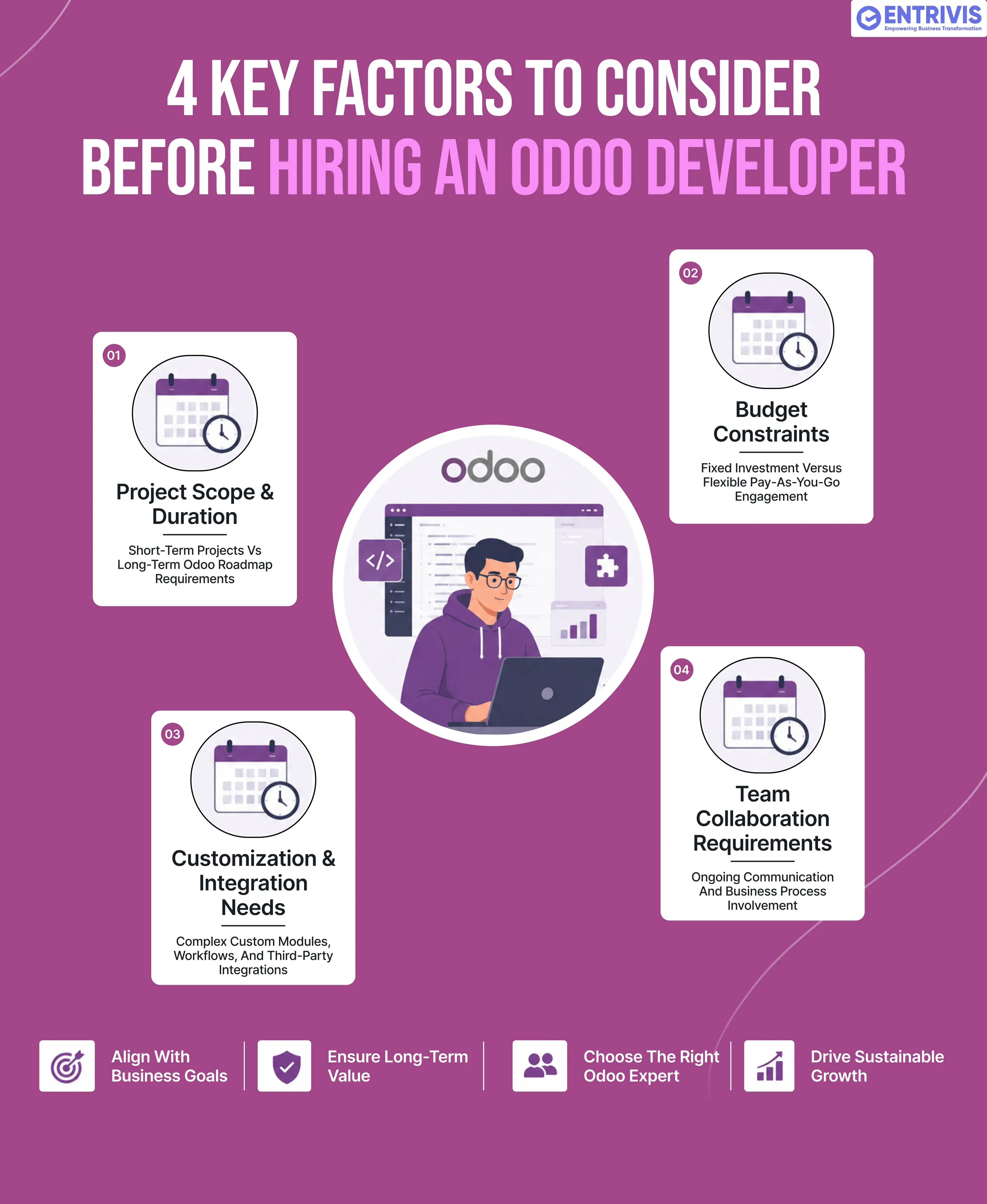
The hiring model decision becomes clearer when you evaluate it through four practical lenses.
1. Project Scope & Duration
The nature of your work is often the single most useful filter.
If you have a defined, bounded project, a new module build, an integration with a specific third-party platform, or a version migration, hourly engagement is likely the more efficient choice. The scope has a beginning and an end, and you're paying for a specific output.
If your Odoo environment is actively evolving, new business units coming online, regulatory changes requiring continuous compliance updates, and growing transaction volumes demanding performance optimization, the work is ongoing. In that context, the continuity that comes with full-time engagement isn't a luxury; it's what makes the system actually work well over time.
2. Budget Constraints
Budget clarity matters here, and it's worth being honest about the full picture, not just the headline number.
Hourly developers appear cheaper on a per-hour comparison. But for long-term, complex work, the cumulative cost of repeated briefing cycles, documentation gaps, and availability delays can quietly erode that initial saving.
Full-time developers carry a higher fixed cost, but when the workload justifies it, the efficiency gain from continuity, faster issue resolution, and deeper system knowledge typically delivers better value per rupee spent.
The honest question isn't "what does an hourly developer cost per hour?", it's "what does this engagement model cost me to achieve the outcome I actually need?"
3. Customization & Integration Needs
If your Odoo environment involves significant Odoo customization, custom modules, bespoke workflows, complex fiscal configurations, or multi-system integration, the technical depth required goes beyond what a rotating roster of hourly developers can reliably sustain.
A developer Odoo specialist who understands your custom codebase, your integration architecture, and your data model will make better decisions at every turn. That kind of deep contextual knowledge is built through sustained engagement, not through repeated onboarding cycles.
For businesses with complex Odoo ERP integration requirements, connecting Odoo to logistics partners, payment systems, eCommerce platforms, or government portals, the integration layer is a living infrastructure that needs ongoing care. This is typically better served by a developer with long-term accountability.
4. Team Collaboration Requirements
Consider how the developer will need to work with your internal teams.
A developer who interacts with your warehouse manager, your finance head, and your operations team daily needs to understand the business, not just the code. That contextual understanding develops over time and through regular collaboration.
If your Odoo implementation is operationally central, meaning business decisions are regularly informed by what the system shows, then the developer working on it needs to be genuinely integrated into your team's communication and decision-making rhythms. That's an organizational fit that hourly models support less reliably.
When to Hire Hourly Odoo Developers
Hourly engagement is the sensible choice in these scenarios:
- You have a specific, well-defined project with a clear start, scope, and end date, a module build, a data migration, and a third-party integration
- You're a startup or early-stage business testing Odoo before committing to a full implementation, an MVP, or a pilot deployment
- Your ongoing Odoo maintenance needs are minimal, the system is stable, changes are infrequent, and you mainly need occasional support
- You need a specialist skill for a short window, a developer with deep knowledge of a specific Odoo module or integration, who you don't need long-term
- Budget is constrained, and project scope is fixed, where controlling cost through defined deliverables is the priority
- You're supplementing an existing team for a high-workload period without adding permanent headcount
To hire Odoo developers on an hourly basis effectively, the key is arriving with clear documentation of what you need, a defined scope, acceptance criteria, and a realistic timeline.
When to Hire Full-Time Odoo Developers
Full-time Odoo developers make the most sense when:
- Odoo is the core infrastructure for your business, not a peripheral tool, but the operational backbone that finance, sales, logistics, and production all run on
- Your ERP environment is continuously evolving, with new modules, regulatory changes, business expansion, and growing transaction volumes
- You've gone through initial implementation and are now in a phase of optimization, growth, and ongoing enhancement
- You operate in a regulated industry where compliance updates are frequent, and the cost of errors is high
- You have a large, complex Odoo setup with significant customization that requires deep, sustained technical ownership
- System downtime has a direct business cost, where a four-hour response cycle isn't acceptable, and immediate availability matters
For enterprises making a strategic, multi-year ERP investment, full-time Odoo developers provide the stability and ownership that protects the value of that investment over time.
Cost Comparison: Hourly vs Full-Time
Understanding the real cost of each model requires looking beyond the headline rate.
Hourly model, what you're actually paying for:
- Billed hours (including ramp-up time at each engagement start)
- Potential premium rates for urgent or specialized work
- Hidden cost of repeated context-setting and documentation gaps
- Possible cost escalation if the scope evolves during the engagement
Full-time model, what you're actually paying for:
- Fixed monthly salary or dedicated resource fee
- Onboarding investment (typically 2-4 weeks to reach full productivity)
- Ongoing HR or partner management overhead (for direct hires)
- Consistent output regardless of workload peaks and troughs
The ROI framing that matters most:
Cost Factor | Hourly | Full-Time |
Monthly cost (light workload) | Lower | Higher |
Monthly cost (heavy, ongoing work) | Can exceed full-time equivalent | Predictable |
Issue resolution speed | Dependent on availability | Immediate |
Ramp-up cost per engagement | Recurring | One-time |
Long-term system quality | Variable | Higher with continuity |
Scalability cost | Linear with hours | Fixed regardless of volume |
For businesses spending more than 60-80 hours per month on Odoo development and support, the economics of full-time engagement typically become more favourable, both financially and operationally.
Expert Recommendation
After working across both models with businesses at different stages and in different industries, the honest guidance comes down to this:
Hire hourly when the work is bound - If you can define what needs to be built, how long it should take, and what done looks like, hourly engagement gives you flexibility, cost control, and access to specialized skills without long-term commitment. It's the right model for projects with clear edges.
Hire full-time when Odoo is an ongoing infrastructure - If your system is continuously evolving, if compliance demands are frequent, if your business depends on the ERP running well every single day, the economics and the operational reality both point toward dedicated engagement. The continuity, the accountability, and the depth of knowledge that come with full-time developers protect your investment and reduce the hidden costs that fragmented engagements accumulate over time.
The hybrid path - Many businesses start with hourly developers for implementation and early customization, then transition to a dedicated developer arrangement as the system matures and ongoing support becomes a constant need. This is a sensible progression, not a compromise.
Whatever model you choose, the quality of the developer and the quality of the partner who places them matter as much as the engagement structure itself. An experienced, well-matched Odoo development services partner will help you make both decisions correctly and support you as your needs evolve.
FAQs
Q1. What skills should I look for when hiring an Odoo developer?
At a minimum, look for strong Python proficiency, hands-on experience with Odoo module development and customization, familiarity with PostgreSQL, and knowledge of the OWL JavaScript framework for frontend work. For Indian businesses, experience with GST localization, e-invoicing integration, and Indian compliance requirements is a significant practical advantage. Always ask for examples of similar projects they've delivered.
Q2. How much does it cost to hire Odoo developers in India?
Rates vary based on experience, specialization, and engagement model. Hourly rates for skilled Odoo developers in India typically range from ₹1,500 to ₹4,500 per hour, depending on expertise level. Full-time dedicated developer costs through a certified partner are typically more cost-effective for sustained engagement than equivalent hourly rates. We'd recommend evaluating the total cost of engagement rather than the per-hour rate in isolation.
Q3. Can I start with hourly and switch to full-time later?
Yes, and this is actually a common and sensible path. Many businesses engage hourly developers for implementation or a specific project phase, then assess their ongoing needs before deciding whether a dedicated full-time arrangement makes more operational and financial sense. A good Odoo development services partner will help you transition smoothly between models as your requirements evolve.
Q4. How long does it take to onboard a full-time Odoo developer?
For a developer joining through a certified partner who already has Odoo expertise, onboarding to your specific system typically takes 2-4 weeks to reach full productivity, assuming good documentation of your existing configuration is available. This is one reason why strong documentation practices during your initial implementation pay dividends later.
Q5. What's the difference between hiring a freelance Odoo developer vs working with a certified Odoo partner?
A freelance developer offers individual expertise. A certified Odoo partner brings a team, which means backup coverage when your primary developer is unavailable, access to broader specializations (frontend, integration, localization), structured project management, and accountability at an organizational level rather than an individual one. For businesses where Odoo is critical infrastructure, the partner model typically provides meaningfully stronger reliability.
Conclusion
The decision to hire Odoo developers on an hourly or full-time basis isn't one you need to get perfect from day one. What matters most is that the model you choose actually fits your current project reality, and that you revisit it honestly as your needs evolve.
Hourly engagement serves bounded projects well. Full-time engagement serves ongoing, complex ERP environments well. And the transition between the two, when timed right, is how many of the most successful Odoo implementations are actually built.
If you're unsure which model makes sense for your specific situation, or if you've had a mixed experience with previous Odoo engagements and want to approach the next phase more strategically, we're happy to help you think it through.
Connect with Entrivistech for a no-obligation conversation. Our team of dedicated Odoo developers works with businesses across India and internationally, and we'll give you an honest assessment of what model is likely to serve your needs best, not just what's easiest to sell.