You've evaluated Odoo. You like what it offers. But somewhere between the demo and the actual deployment, a question surfaces: Does the standard version really fit how our business works?
For most growing businesses, the answer is no, not entirely. And that gap is exactly where custom Odoo development services become the difference between an ERP that transforms operations and one that your team works around.
This guide is for CTOs, founders, and operations heads who are making that call. No hype, no pressure, just what you need to know to make a sound decision.
Why Odoo Customization Matters Today
Off-the-shelf ERP rarely fits growing businesses out of the box. It fits a version of your business, the generalized, averaged-out version that software vendors design for the broadest possible audience.
Your business isn't average. You have specific workflows, approval chains, reporting formats, customer-facing processes, and compliance obligations that standard modules don't account for. The moment you start forcing your team to work differently just to match the software, you've lost the plot.
Odoo customization services exist to close that gap. As businesses scale, adding locations, product lines, teams, or markets, the need for a system that mirrors real operations becomes critical. Customization isn't a luxury. For businesses with any meaningful complexity, it's the foundation of ERP success.
What Are Custom Odoo Development Services?
Custom Odoo development services refer to the process of building upon, modifying, or extending Odoo's core functionality to suit your specific business requirements beyond what standard configuration allows.
This can take several forms. Custom module development creates entirely new features within Odoo that don't exist in the base platform. Workflow automation configures multi-step approvals, triggers, and logic that match your actual decision-making processes. Third-party integrations connect Odoo to external tools - payment gateways, logistics APIs, e-commerce platforms, or legacy systems you're not yet ready to retire.
An Odoo development service might also include custom reports and dashboards, role-based access controls, industry-specific compliance configurations, or UI modifications that improve how your team interacts with the system daily.
In short, if standard Odoo is the foundation, custom development is the architecture that makes it yours.
When Does Your Business Need Odoo Customization?
Not every business needs deep customization on day one. But certain signals indicate that standard Odoo, even with configuration, won't take you where you need to go.
You likely need custom Odoo services if:
- Your workflows involve multi-step approvals or conditional logic that standard modules can't replicate without heavy workarounds
- You operate across multiple locations, warehouses, or legal entities with different compliance requirements
- You need Odoo to exchange data with systems that don't have a native Odoo connector
- Your reporting needs go beyond standard dashboards; you need custom KPIs, dimensional reports, or executive views built for your business model
- You're in a regulated industry (pharma, food processing, financial services) where audit trails, certifications, and document controls need to be built into the system
- Your customer-facing processes, quotes, portals, and order confirmations need to reflect your brand and workflows, not Odoo's default
If two or more of these apply to your business, a conversation with a capable Odoo development company is well worth your time.
Key Features to Look for in an Odoo Development Company
The difference between a smooth implementation and a difficult one often comes down to who you hire, not what platform you choose. Here's what to evaluate seriously.
Technical Expertise & Certifications
An Odoo development company worth working with will have certified developers on staff who have completed Odoo's official technical and functional certification programs. This matters because Odoo's framework has specifics: ORM, QWeb templating, the module inheritance system, and version migration paths all require hands-on experience, not just general Python knowledge.
Ask about version expertise. If you're moving to Odoo 17, you want a team that has worked in that version, not one that's still primarily operating in Odoo 14 or 15. Also, ask about their development environment practices: testing protocols, staging deployments, and code review processes. These details separate professional delivery from ad hoc development.
Official Odoo partnership status - Ready, Silver, or Gold signals that the company meets Odoo's standards for technical competence and client delivery. It also creates accountability through Odoo's partner network.
Customization vs. Configuration
This distinction matters more than most clients realize, and a good partner will explain it clearly before scoping your project.
- Configuration means adjusting Odoo's existing settings: enabling modules, defining workflows within the platform's native options, setting access rights, and adapting standard fields. It's faster, lower cost, and fully upgrade-safe.
- Customization means writing code, creating new modules, modifying core behavior, or building integrations. It requires more time, carries upgrade considerations, and should only be done when the configuration genuinely can't meet the requirement.
A practical example: setting up a multi-step invoice approval configuration. Building a custom procurement workflow that pulls data from an external supplier portal and auto-generates POs based on inventory thresholds that's customization.
The right custom Odoo development services provider will always try to solve your problem with configuration first, and only move to custom code when the business case genuinely justifies it.
Benefits of Choosing Custom Odoo Services
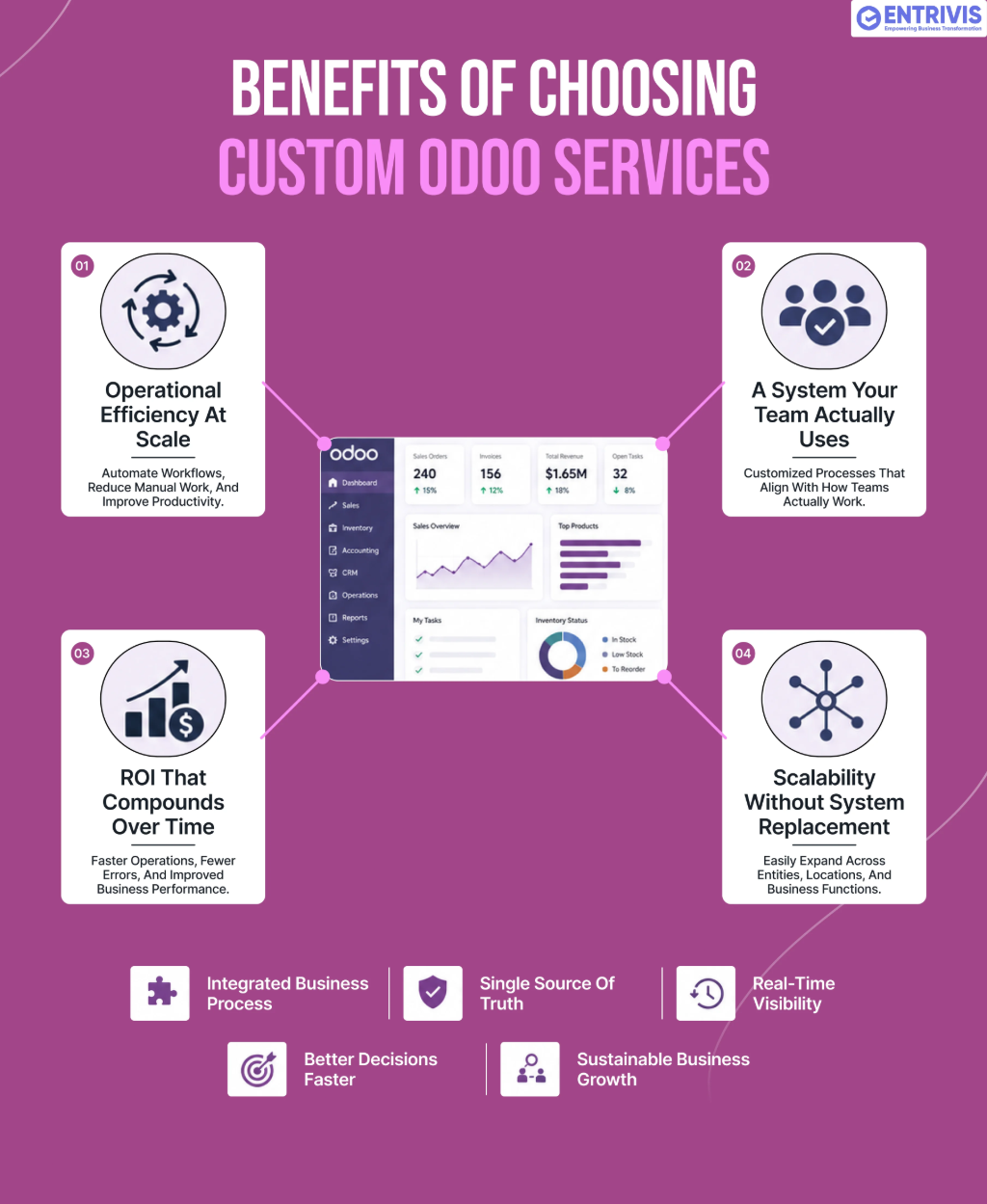
When implemented thoughtfully, custom Odoo services deliver measurable outcomes, not just technical capability.
- Operational efficiency at scale - Automation built around your actual processes eliminates manual steps, reduces errors, and frees your team for higher-value work. A distribution company that used to manually reconcile three spreadsheets daily doesn't need to after a custom integration connects Odoo with their logistics platform.
- A system your team actually uses - Adoption is the most underrated metric in ERP success. When Odoo is configured and customized to reflect how your people actually work, resistance drops and usage climbs. You get better data quality, better reporting, and faster decisions.
- ROI that compounds over time - Custom development is an upfront investment, but it pays dividends across every business cycle that follows. Faster quote-to-cash cycles, fewer billing errors, and real-time inventory visibility; these outcomes translate directly to cost savings and revenue gains.
- Scalability without system replacement - A well-architected custom Odoo implementation grows with your business. Adding a new entity, a new country, or a new product category doesn't require starting over; it requires extending what's already there.
Common Mistakes to Avoid When Hiring
Choosing the wrong Odoo development service provider is a recoverable mistake, but it's expensive and time-consuming to fix. These are the most common missteps.
- Choosing based on price alone - A significantly lower quote usually reflects shorter timelines, less experienced developers, or a scope that doesn't account for testing, documentation, and post-launch support. You may save in the short term and pay considerably more in corrections later.
- Skipping documentation requirements - Every custom module should come with functional documentation on what it does, how it integrates with other parts of the system, and how to maintain it. Without documentation, you're dependent on the original developer forever, even for small changes.
- No clarity on post-go-live support - Custom development doesn't end at deployment. Bugs surface during real-world use. Business requirements evolve. Odoo releases updates. A partner without a defined support model leaves you exposed at precisely the moment you need them most.
- Underestimating data migration complexity - If you're moving from another ERP or a set of spreadsheets, data migration deserves its own scoped phase with validation, mapping, and testing. Treating it as an afterthought is one of the most reliable ways to delay a go-live.
Cost Factors in Custom Odoo Development
Budgeting for custom Odoo development services requires understanding what drives cost. There's no universal pricing, and any partner who quotes you without first understanding your requirements is guessing.
- Scope of customization - A single custom report costs far less than a full custom procurement workflow with external system integration. The more deeply you deviate from Odoo's standard behavior, the more development time is involved.
- Number and complexity of integrations - Connecting Odoo to a single payment gateway is straightforward. Connecting it to a real-time inventory system, a customer-facing portal, and a legacy ERP simultaneously is a different engagement entirely.
- Data volume and migration requirements - Migrating five years of transactional data with full mapping and validation takes significantly more time than a clean-start implementation.
- Timeline and team size - Compressed timelines require larger development teams, which increases cost. A realistic, phased approach is almost always more cost-efficient than a rush deployment.
- Ongoing support model - Factor post-go-live support into your total cost of ownership, not just the implementation fee. A support retainer with defined SLAs is a predictable cost. Emergency fixes with no plan are not.
How to Choose the Right Odoo Development Partner
Use this as your working checklist when evaluating potential partners for Odoo development company selection:
- Do they have certified Odoo developers, and at what tier is their official partnership?
- Can they share case studies from businesses in your industry or with similar complexity?
- Do they explain the difference between configuration and customization, and try configuration first?
- Is their project methodology documented, with clear milestones and deliverables?
- Do they include a UAT (User Acceptance Testing) phase before go-live?
- Is post-go-live support clearly scoped, with defined SLAs?
- Do they have experience with India-specific compliance, GST, e-invoicing, and TDS if relevant to your operations?
- Are their developers familiar with the Odoo version you're targeting?
- Do they provide source code ownership and technical documentation as part of delivery?
A partner who can answer all of these questions clearly, without hedging, is worth serious consideration. One who deflects or gives vague answers on any of them deserves a follow-up.
Why Businesses Prefer Custom Odoo Over Ready-Made ERP
The ERP market has no shortage of ready-made solutions. So why are businesses increasingly moving toward Odoo customization services over packaged alternatives?
- Ownership and control - With Odoo's open-source foundation, you own your system. You're not locked into a vendor's roadmap or held hostage by licensing changes. You decide how the system evolves.
- Flexibility without full replacement - Proprietary ERPs force you into their upgrade paths and module ecosystems. With Odoo, you can extend specific capabilities while leaving the rest of the system untouched. Customization is surgical, not systemic.
- Long-term cost efficiency - Licensing fees for proprietary ERP compounds are annual, often without corresponding value. Odoo's community edition is open-source, and enterprise licensing is straightforward. Your investment goes into implementation and customization, not perpetual access fees.
- Scalability on your terms - As your business grows, Odoo grows with it. You add what you need, when you need it, without renegotiating an enterprise software agreement.
For businesses that have outgrown spreadsheets but don't want to be locked into a rigid, expensive platform, Odoo represents a genuinely better path.
Final Thoughts: Making the Right Investment
Custom Odoo development services are a strategic investment in your operations, your team's productivity, and your ability to scale without friction. Approaching it as a cost to minimize, rather than a capability to build, almost always leads to a system that delivers less than it should.
The businesses that get the most from Odoo are the ones who chose a partner invested in their long-term success, not just in closing the project. They asked hard questions before signing, planned for post-go-live support, and treated implementation as the beginning of a working relationship, not the end of a transaction.
At Entrivis Tech, that's exactly how we approach every engagement. From initial discovery to post-go-live support, we're here to make sure Odoo works for your business, not the other way around.
If you're ready to explore what custom Odoo can do for your operations, book your free Odoo consultation with Entrivis Tech with a straightforward conversation.