Running a fleet, whether it's 10 vehicles or 500, is one of those operational challenges that quietly eats into your margins if you're not careful. Missed service schedules, untracked fuel usage, expired licenses, vehicles sitting idle... these aren't rare problems. They're everyday headaches for fleet managers across India and around the world.
That's exactly where an ERP system for fleet management changes things. And when it comes to ERP platforms built for real-world business, Odoo Fleet stands out for being practical, integrated, and surprisingly easy to work with. In this article, we'll walk through how Odoo fleet management actually works, what it does that spreadsheets and disconnected tools simply can't, and why more businesses are switching to a centralised ERP approach.
What Is Odoo Fleet Management And Why Does It Matter?
Odoo is an open-source ERP platform that covers everything from accounting and HR to manufacturing and sales. The Fleet module sits inside this ecosystem, which means your vehicle data doesn't live in isolation. It talks to your finance department, your HR team, and your purchase orders, all in one place.
The Odoo Fleet module is built to manage the complete lifecycle of every vehicle in your organisation. From the moment a vehicle is added to your fleet, you can track its documents, schedule its maintenance, log its fuel costs, assign it to drivers, and eventually plan its replacement. No switching between apps, no manual data reconciliation.
For businesses in India that rely heavily on logistics, field services, transportation, or even corporate travel, this kind of centralised visibility isn't a luxury; it's a necessity.
Key Features of the Odoo Fleet Module
Vehicle Registration and Document Management
Every vehicle in Odoo gets its own profile. Model, year, registration number, insurance policy, emission certificate, and fitness certificate are all stored and linked to automated alerts before expiry. If your driver's licence or vehicle insurance is about to lapse, the system notifies the right person before it becomes a compliance problem.
This alone saves fleet managers hours of manual tracking every month, and removes the embarrassing (and costly) situation of a vehicle being stopped because of an expired document.
Maintenance Planning and Service History
One of the most underappreciated aspects of the Odoo ERP system for fleet management is how it handles maintenance. You can set up preventive maintenance schedules based on either mileage or time intervals. When a vehicle hits a threshold, a service request is automatically triggered.
Every repair and service visit is logged against the vehicle's record. Over time, this builds a full maintenance history useful when you need to decide whether a vehicle is worth keeping or should be retired. It also helps identify patterns: if the same vehicle keeps needing repairs, the data makes that visible before it becomes a serious cost issue.
Fuel and Cost Tracking
Fuel is typically the largest variable expense in a fleet operation. Odoo lets you log every fuel fill-up against a specific vehicle, track consumption over time, and generate reports that show you which vehicles are fuel-efficient and which ones are draining your budget.
Beyond fuel, all operating costs, tyres, tolls, driver allowances, and accident repairs can be captured in one place. When this data feeds directly into your Odoo accounting module (which it naturally does), your finance team gets accurate cost-per-vehicle figures without anyone having to manually compile spreadsheets.
Driver Management and Assignment
Odoo Fleet allows you to maintain a driver database, contact details, licence information, validity dates, and assign vehicles to specific drivers. You can track who has been using which vehicle and when. This is particularly useful for accountability, for insurance purposes, and for managing driver performance over time.
If you're working with Odoo implementation experts who understand your industry, driver assignment workflows can be customised to match how your operations actually run, shift-based, project-based, or long-term assignment.
Fleet Reporting and Analytics
Odoo's reporting tools are genuinely useful here. You can pull dashboards showing fleet utilisation rates, total cost of ownership per vehicle, vehicles due for service, and contract expirations. These aren't just numbers on a screen, they're the kind of insights that help management make real decisions: when to replace ageing vehicles, which routes are most cost-efficient, and how to reduce idle time.
How Odoo ERP Connects Fleet to the Rest of Your Business
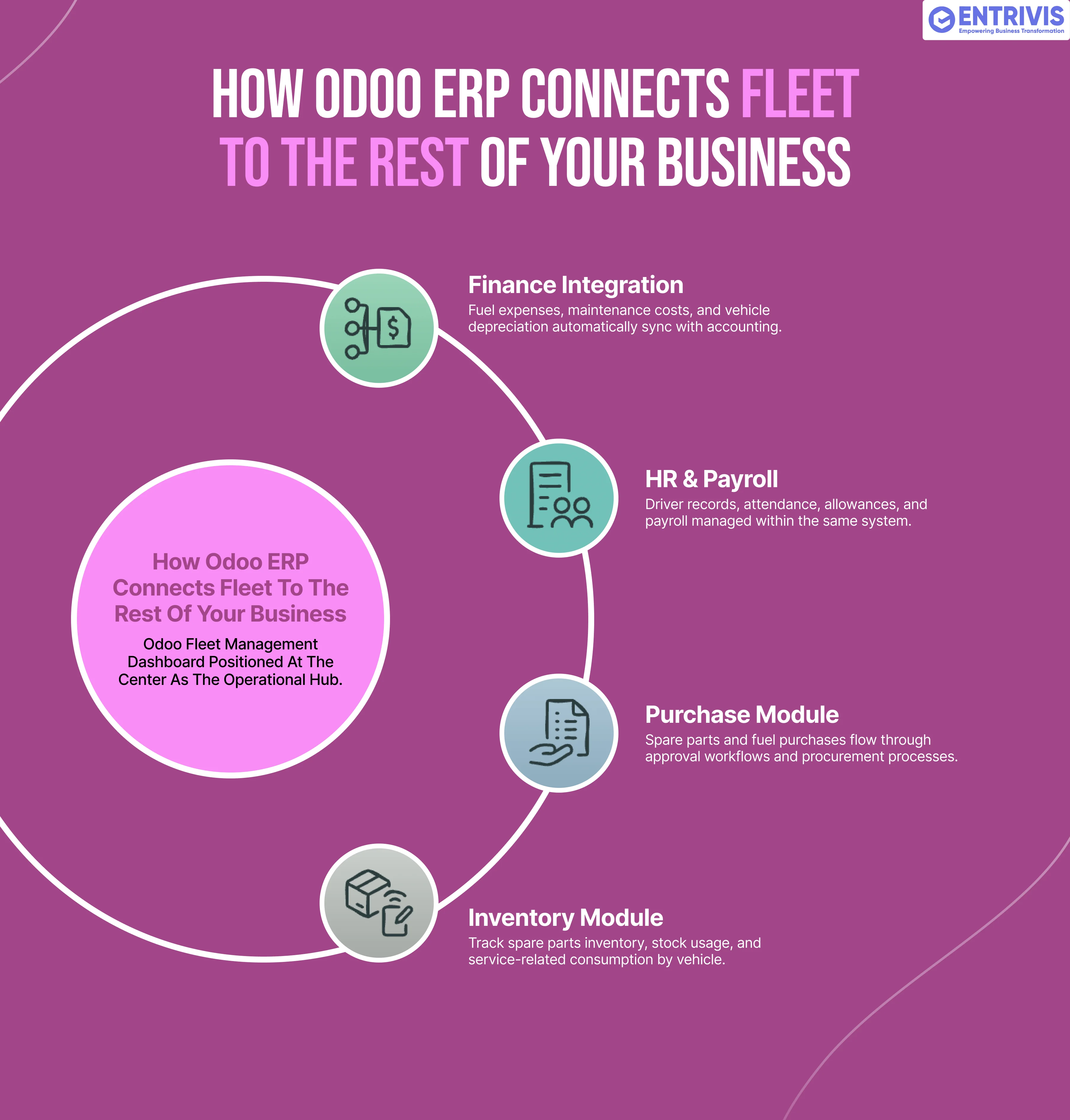
This is honestly where Odoo pulls ahead of standalone fleet tracking software. Because it's a full ERP, fleet data doesn't live in a silo.
- Finance integration: Every fuel log, maintenance invoice, and vehicle depreciation entry connects directly to your accounts. No duplicate entry, no reconciliation headaches at month-end.
- HR and payroll: Driver records link to your HR module. Allowances, deductions, and attendance are all managed within the same system.
- Purchase module: Need to order spare parts or fuel cards? Raise a purchase order within Odoo, and it flows through your approval hierarchy before being committed. All costs tie back to the relevant vehicle record.
- Inventory module: If you maintain an internal parts store, inventory levels and usage can be tracked against specific vehicles and service orders.
This kind of integration is exactly what an ERP system for fleet management should deliver, not just a digital logbook, but a connected operational backbone.
If you're evaluating whether Odoo is the right fit for your specific setup, an Odoo consulting engagement can map your current processes to what Odoo can deliver, so there are no surprises after implementation.
Common Challenges Odoo Fleet Solves
Let's be honest, most fleet operations in India are still running on some combination of Excel sheets, WhatsApp messages, and memory. That works until it doesn't. Here's what typically breaks:
Early warning on document expiry - Insurance lapses, drivers get stopped at checkposts. With Odoo, automated alerts go out weeks in advance.
Visibility on actual costs - You know fuel is expensive, but which vehicles are the worst offenders? Without per-vehicle cost tracking, you're guessing. Odoo shows you the data.
Maintenance is reactive, not preventive - Vehicles break down because service was missed. Odoo's scheduled maintenance prevents that, and the system reminds you before the interval lapses.
Finance and operations are disconnected - Your accounts team is always chasing fleet managers for invoices. With Odoo, costs are logged at the source and flow to finance automatically.
Scaling is painful - Adding 20 more vehicles to an Excel-based system is a nightmare. In Odoo, it's just adding more records to the same structure.
Getting Started with Odoo Fleet: What the Implementation Looks Like
Implementing Odoo Fleet isn't something that needs to take months. For most businesses, the module can be configured and live within a few weeks, especially when you work with an experienced Odoo implementation partner who understands fleet operations.
The typical process looks like this:
First, your existing vehicle data gets migrated into Odoo details, documents, and service history if available. Then workflows are configured: maintenance triggers, alert thresholds, cost categories, and approval levels. Users get trained on their specific roles, whether that's a fleet manager logging a fuel fill-up or a finance executive reviewing monthly vehicle costs.
Post go-live, a good implementation partner stays involved. If something needs tweaking, a custom report, an integration with a GPS tracking system, or a custom approval flow, that's where Odoo development work comes in. Odoo is modular and open, so these customisations are very achievable.
And if your organisation already uses an older ERP or a different Odoo version, Odoo migration services can bring your historical data across cleanly.
Is Odoo Fleet Right for Your Business?
Odoo Fleet works well for a fairly wide range of organisations. If any of these describe your situation, it's worth a closer look:
You operate more than five vehicles regularly. Below that, manual tracking is manageable. Above it, the complexity starts to compound, and things get missed.
Your vehicles directly affect service delivery or revenue. For logistics companies, field service businesses, construction firms, or any organisation where vehicle availability directly impacts operational costs and compliance visibility matters a lot.
You're already using or planning to use Odoo for other departments. In that case, Fleet is a natural addition. The integration benefits are immediate.
You're growing. If your fleet is going to get bigger, building good systems now saves a lot of pain later. Retrofitting processes onto a large fleet is significantly harder than starting right.
Frequently Asked Questions About Odoo Fleet Management
What is Odoo Fleet used for?
Odoo Fleet manages vehicle records, maintenance schedules, fuel logs, driver assignments, and costs all in one place.
Can Odoo ERP handle large fleet operations?
Yes, Odoo scales well and is used by companies managing hundreds of vehicles across multiple locations.
Does Odoo Fleet integrate with GPS tracking systems?
Odoo can be integrated with external GPS tools through custom development or available connectors.
How does Odoo help reduce fleet operating costs?
By tracking fuel consumption, maintenance costs, and utilisation rates per vehicle, it identifies inefficiencies quickly.
Can Odoo send alerts for vehicle document expiry?
Yes, Odoo Fleet sends automated notifications before insurance, registration, or licence expiry dates.
Is Odoo Fleet suitable for small businesses?
Yes, even small fleets benefit from organised records, automated reminders, and integrated cost tracking.
What is the difference between Odoo Fleet and standalone fleet software?
Odoo Fleet connects with finance, HR, and procurement; standalone tools typically don't offer this integration.
How long does it take to implement Odoo Fleet?
For most businesses, a basic implementation takes two to four weeks, depending on data complexity and customisation needs.
Can Odoo Fleet track driver performance?
Driver records, vehicle assignments, and fuel logs provide useful data to monitor usage patterns and costs per driver.
Do I need technical knowledge to use Odoo Fleet?
No, Odoo has an intuitive interface, and with proper training, fleet managers can use it without any technical background.
Your Fleet Deserves Better Than a Spreadsheet
Managing a fleet well is genuinely complex, including documents, costs, maintenance, drivers, and compliance. Doing it across disconnected systems is exhausting and error-prone. An ERP system for fleet management, and specifically Odoo Fleet, brings all of that under one roof, connects it to your financials, and gives you actual visibility into what's happening.
If you're curious about what an implementation would look like for your organisation or want to see Odoo Fleet live before committing, book a free Odoo demo with Entrivis Tech. They work with businesses across India on Odoo implementations and can walk you through exactly how the Fleet module fits your specific operations.