Healthcare administration is relentless. Between managing patient appointments, maintaining medical records, handling billing and insurance, tracking inventory, and keeping staff organised, the operational side of running a hospital or clinic can feel like a second full-time job on top of the actual medical work.
Most facilities in India and across the region are juggling multiple disconnected systems, one for billing, another for patient records, maybe a manual register for appointments. It works until a patient file goes missing, an invoice gets duplicated, or the pharmacy runs out of something critical because no one got the alert in time.
That's the problem an ERP system addresses. And specifically, Odoo hospital management is becoming a go-to choice for healthcare facilities that want to streamline operations without bringing in a massive IT overhaul. In this article, we'll break down what Odoo does for hospitals and clinics, which modules actually matter, and what a real implementation looks like in practice.
Why Hospitals and Clinics Need an ERP - Not Just Software
There's no shortage of standalone healthcare software. Patient management apps, billing tools, and appointment schedulers can find all of these individually. The problem is that they don't talk to each other.
When a patient is admitted, their information needs to flow from registration to the treating doctor, to the pharmacy, to the lab, to billing, all without someone manually transferring data between systems. When that doesn't happen seamlessly, errors creep in. Duplicate billing, missing lab results, and delayed prescriptions.
An ERP is designed precisely to solve this. It connects every department under one platform, so data entered in one place flows automatically where it needs to go. Odoo clinic management system does this effectively, and because it's modular, a facility can start with the modules they need and expand over time.
What Odoo Hospital Management Actually Covers
Patient Registration and Records
At the core of any hospital or clinic operation is the patient record. Odoo allows you to maintain a complete electronic health record for each patient's demographics, visit history, diagnoses, prescriptions, lab results, allergies, and notes from every consultation.
When a returning patient walks in, the front desk pulls up their record in seconds. The doctor sees their full history before the consultation begins. There's no hunting through filing cabinets or asking the patient to repeat information they've given four times before.
For multi-branch hospitals or clinic chains, patient records are accessible across locations, so a patient visiting a different branch gets the same continuity of care.
Appointment and Scheduling Management
Odoo's appointment module lets reception staff manage doctor schedules, patient bookings, and room allocation from one screen. Walk-ins, phone bookings, and online appointments can all be handled in the same system.
Automated reminders via SMS or email reduce no-shows, a very real revenue problem for many clinics. The system can also flag double-bookings or schedule conflicts before they cause problems.
For specialist clinics managing multiple doctors with different availability and consultation types, this kind of structured scheduling tool makes a genuine difference to day-to-day operations.
Billing, Invoicing, and Insurance Claims
Healthcare billing is complicated. Between consultation fees, lab charges, procedure costs, pharmacy items, and insurance co-pays, a single patient visit can generate a surprisingly complex invoice. Getting this right, every time, is both operationally important and directly tied to revenue.
Odoo's billing module within the hospital management setup automatically generates invoices based on the services provided. If the patient has insurance coverage, the system can handle the claim documentation and track reimbursement status.
Because billing in Odoo connects directly to the accounting module, there's no manual reconciliation needed. Finance gets real-time visibility into revenue, outstanding payments, and insurance claim status without anyone manually transferring data.
If you're working with an Odoo implementation partner familiar with healthcare operations, the billing workflows can be configured to match your specific fee structures, insurance empanelments, and regulatory requirements.
Pharmacy and Inventory Management
This is one of the more practical wins of running Odoo as your clinic management system. The pharmacy module manages drug inventory stock levels, expiry dates, supplier orders, and consumption tracking.
When a doctor prescribes medication within the system, the pharmacy receives the prescription digitally. Stock levels update automatically when medication is dispensed. When a drug drops below its reorder threshold, a purchase request is triggered.
The result is fewer stockouts, less manual counting, and no expired medications sitting on shelves unnoticed. For hospitals managing large formularies, this kind of automation is not optional; it's essential.
The pharmacy module connects natively to Odoo's purchase and accounting modules, so procurement approvals, supplier payments, and cost-of-goods tracking all happen within the same system.
Lab and Diagnostics Workflow
Labs are often a bottleneck in clinical operations. Requests get lost, results take time to communicate back to doctors, and patients wait unnecessarily for reports.
Odoo's lab management capability allows test requests to be raised digitally from the consultation. The lab team receives the request, processes the sample, and enters results directly into the patient's record. The doctor is notified when results are ready. No phone calls, no paper slips, no delays in the communication chain.
For clinics that outsource certain diagnostic tests, the same workflow applies: the request goes out, results come back in, and everything is tracked against the patient's record and the associated invoice.
HR, Payroll, and Staff Management
A hospital's largest operating expense is usually its people. Odoo's HR module manages staff records, attendance, leave, shifts, and payroll all within the same platform.
Shift scheduling for nursing staff, attendance tracking for housekeeping, and leave approval for doctors are handled without needing a separate HR system. Payroll runs are based on actual attendance data, reducing the manual calculation errors that are surprisingly common in facilities still using spreadsheets.
If you want to understand how Odoo's HR capabilities fit your specific staffing model, an Odoo consulting session can map your workflows before any implementation work begins.
How Odoo Connects the Whole Hospital, Not Just Individual Departments
The real value of using an ERP like Odoo for hospital management isn't just in each module. It's in how they connect.
Think about what happens when a patient is admitted for a surgical procedure. Registration creates the patient file. The consultant's notes are added during pre-operative assessment. The pharmacy receives the pre-op medication request. The theatre is scheduled. Lab results from pre-surgical tests are attached to the record. Post-procedure, the nursing staff updates the ward notes. When the patient is discharged, billing automatically compiles every charge consultation, theatre, medication, lab tests, and room charges into a single invoice. Finance sees it immediately. Insurance documentation is generated if needed.
That entire chain, across departments that traditionally operate in silos, happens within one system. No data entry duplication. No gaps in the record. No delays because someone is waiting on information from another department.
This is what a well-implemented Odoo clinic management system actually delivers, not just digital forms, but genuinely connected operations.
Common Pain Points Odoo Solves for Healthcare Facilities
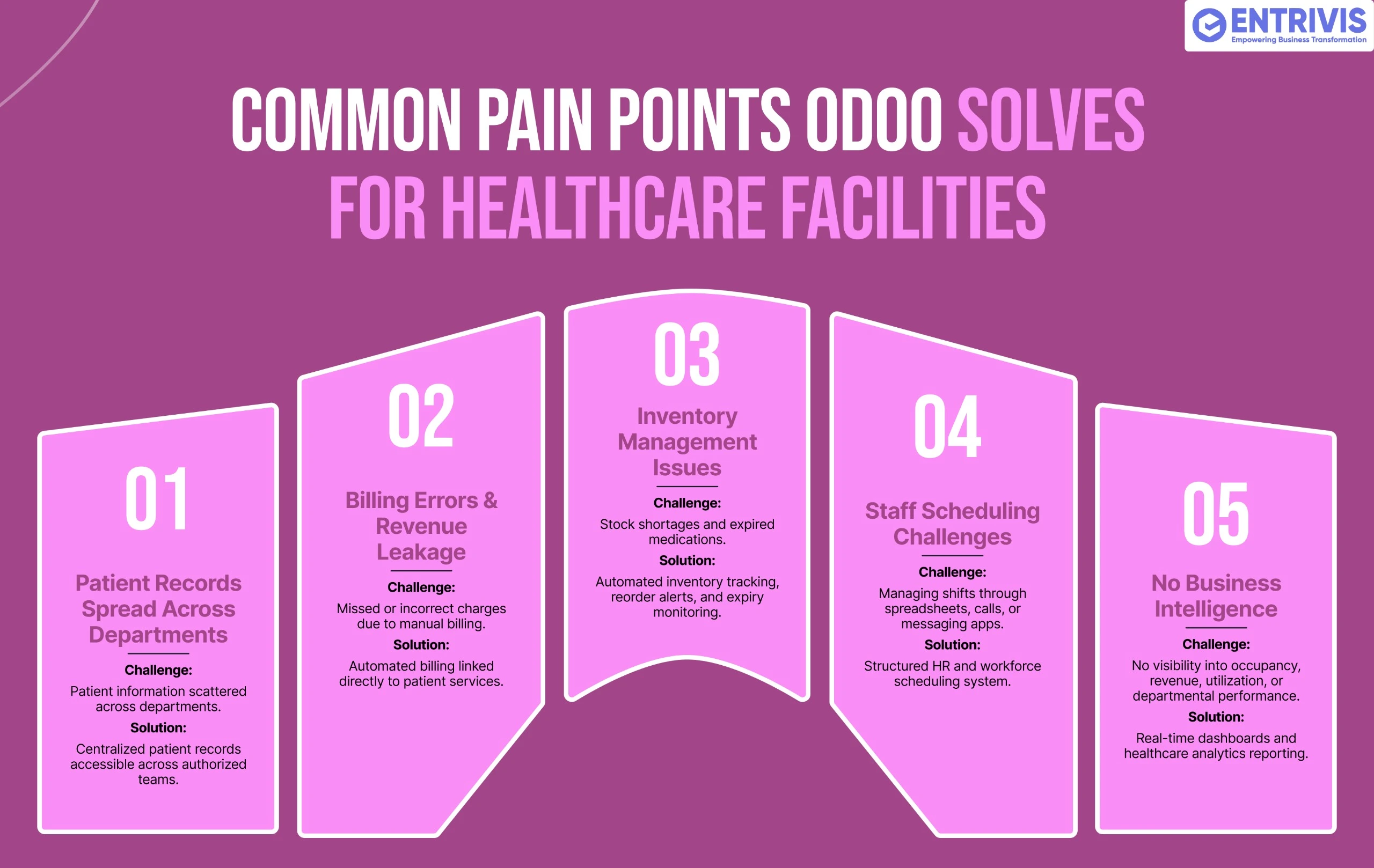
Let's get specific about what typically goes wrong in hospitals and clinics that haven't yet centralised their systems:
- Patient records spread across departments - Doctors can't see what billing has recorded. The pharmacy doesn't know about the allergies noted in consultation. Odoo fixes this one record, accessible by everyone with the right permissions.
- Billing errors and revenue leakage - Services provided but not billed, or billed incorrectly because someone had to compile the invoice manually. With Odoo, charges are captured at the point of service.
- Inventory Management Issues - Running out of critical supplies because no one noticed stock was low, or discovering expired medications during a manual audit. Automated reorder alerts and expiry tracking prevent both.
- Staff Scheduling Challenges - Shift management by WhatsApp messages and paper rosters doesn't scale. Odoo's HR module brings structure and an audit trail.
- No business intelligence - Management has no visibility into occupancy rates, revenue per department, cost trends, or resource utilisation because data is scattered. Odoo's reporting dashboards bring all of it together.
Implementing Odoo for Your Hospital or Clinic: What to Expect
A healthcare implementation is more nuanced than, say, setting up Odoo for a manufacturing company. Patient data is sensitive. Regulatory compliance matters. Workflows are complex and often non-negotiable.
A good Odoo implementation for a healthcare facility typically starts with a detailed process mapping exercise, understanding how the facility currently operates and what gaps exist. From there, the system is configured to match real workflows, not the other way around.
Data migration is usually a significant part of the project. Existing patient records, billing history, and inventory data need to come across cleanly. This is where working with an experienced partner who has done healthcare implementations before makes a real difference. The technical knowledge of Odoo development, combined with domain understanding, helps avoid the mistakes that derail these projects.
Training is equally important. Doctors, nurses, reception staff, pharmacists, and finance teams each have different workflows and need tailored training, not a generic one-hour session. Ongoing Odoo support after go-live ensures that questions get answered and refinements get made as users settle into the system.
For facilities already running an older version of Odoo or a different system, Odoo migration services ensure historical data is preserved and accessible in the new setup.
Is Odoo the Right Fit for Your Facility?
Odoo hospital management works well across a range of healthcare settings, from single-specialty clinics to multi-department hospitals. It's particularly well-suited when:
You're running multiple departments that currently don't share information effectively. The integration benefits are immediate and significant.
You have a growing facility. Starting with solid systems now is far easier than trying to retrofit them later when complexity has multiplied.
You want cost visibility. Healthcare facilities often don't have a clear line-of-sight into cost per department, per patient, or per procedure. Odoo's reporting can change that.
You're already using Odoo for finance or HR and want to extend it to clinical operations. Adding the health-specific modules to an existing Odoo instance is relatively straightforward.
Frequently Asked Questions About Odoo for Hospitals and Clinics
What is Odoo hospital management?
It's an ERP module that manages patient records, billing, appointments, pharmacy, lab, and staff all in one connected system.
Can Odoo be used for a small clinic?
Yes. Odoo is modular, so a small clinic can start with just appointments, billing, and records without the full hospital setup.
Does Odoo support electronic medical records?
Yes, Odoo maintains complete patient histories including diagnoses, prescriptions, lab results, and doctor notes per visit.
How does Odoo handle hospital billing and insurance?
It auto-generates invoices from services rendered and supports insurance claim documentation and reimbursement tracking.
Can the pharmacy module track drug expiry dates?
Yes, Odoo pharmacy management tracks stock levels, expiry dates, and triggers reorder alerts automatically.
Is patient data secure in Odoo?
Odoo has role-based access controls, so each staff member sees only the data relevant to their function.
Can Odoo manage multiple hospital branches?
Yes, Odoo supports multi-location setups with shared patient records and centralised reporting across branches.
How long does it take to implement Odoo for a hospital?
Depending on facility size and complexity, a typical implementation takes four to twelve weeks.
Does Odoo integrate with lab equipment or diagnostic devices?
Integration is possible through custom development, connecting lab systems to Odoo for automated result uploads.
What ongoing support is available after going live?
Experienced Odoo partners provide post-go-live support for troubleshooting, user questions, and system refinements.
Ready to Stop Managing Healthcare Operations the Hard Way?
The gap between how most healthcare facilities manage their operations today and what's actually possible with a well-implemented ERP is significant. Better patient experience, fewer billing errors, smarter inventory, connected departments, these aren't theoretical outcomes. They're what healthcare facilities see when they move from fragmented tools to a single, properly configured system.
Odoo clinic management system gives you the flexibility to start where you need to and grow from there. And having the right implementation partner, one that understands both the technology and the healthcare context, makes all the difference in getting there without unnecessary complexity or cost.
Reach out to Entrivis Tech to talk through what an Odoo implementation would look like for your hospital or clinic. Or, if you'd rather see it first, book a free demo and walk through the system with their team.